"Canada would increasingly resemble the U.S., a model that makes European countries shudder. Guns on the street, gated communities, rampant drug use, unlimited anonymous corporate political donations, no government safety standards for food and medicine, classrooms that resemble holding pens more than civilized safe rooms for the young to learn . . . If Harper got his majority, these things would hit us like an avalanche.
Citizens regarded as 'ethnics' would be courted until election day, and then abandoned. Forget family reunification, forget federal money to ease non-whites' path into Canadian society, forget English classes.
Women's rights would retreat, including abortion rights, access to medical advances and the right to go to court to protest inequality.
Everything would be up for privatization, from roads, parks and parking meters to schools and hospitals."
From Mallick's perspective, one would think of the Conservatives as reactionary, chauvinist, ultra-libertarian racists who would fundamentally dismantle Canada's hitherto existing society and reshape it into some kind of horrible arch-conservative dreamworld.
What would make someone so afraid of a Conservative majority that they would imagine such a world? What did the Conservatives do while forming a minority-government to make Heather Mallick so hysterical?
It seems that, rather than basing her opinions and predictions on what the Conservatives had actually done while forming the government, she based them on certain things they may have said or what she feared they might do - with no strong grounding in facts.

Nothing in what the Conservative Party had done up to then would have made her believe that "old-tyme religion" would reign, or that abortion rights would be repealed, gay marriage abolished, or anything else that she so fervently fear-mongered. Any reasonable, non-partisan person who assessed the Conservatives' platform and their previous policies would know that they would never introduce such reactionary social legislation, because it would mean the death of their mandate. Canada is, after all, a country that is leans left on social issues but is more fiscally conservative - the Conservative Party had done its best over the years to mold itself to fit into this niche.
This is not to say that the Conservatives had been completely centrist and pragmatic in their years of minority-government; they had enacted some rather minor tax cuts, business tax breaks, and a few pieces of "red meat" for their base - reforming the long-form census and purchasing some fighter jets. But what seems to be utterly incomprehensible to Mallick is that none of these things could have happened without other parties voting for them due to the minority-ness of the Conservatives' government - including her beloved Liberal Party. Even when the Conservatives did commit a truly anti-democratic act - the prorogation of Parliament before the 2010 Winter Olympics in Vancouver - as much blame should be apportioned to the Governor-General for accepting the Prime Minister's request. The electorate as well clearly didn't think much of the other parties voting to censure the Conservatives, as their percent of electoral support only increased from the previous election.

In short, it appears that Mallick was judging the Conservatives by their words (or what she assumed was their nefarious, secret plan ensconced in their ideological id) rather than their actions. Their words may sometimes mark them out for being more ideologically on the Right, while their actions - for the most part - suggested that they much more often than not took the centrist approach to politics rather than a hard right one. [This may all change, as the Conservatives did indeed win a majority after the 2011 election and now have no need to court the votes of other parties in Parliament]
While non-conservatives in Canada may fear and imagine the worst from their newly-elected government, American conservatives have spent the last several years warning anyone who would listen of the "radicalness" of the Obama administration. The National Rifle Association, for example, has claimed that the President is merely biding his time for after the 2012 election to completely ban guns and abrogate the 2nd Amendment (the fiend!). They believe this, despite literally no factual policies or quotations from the administration, and after a United States Congresswoman was shot in the head by someone, and after the only policy that Obama has implemented with regards to gun control actually expanded Americans' 2nd Amendment rights.
American conservatives, just like Canadian non-conservatives, seem to be judging the President by what they think he will do, based upon what he has said rather than done.
If President Obama's statements were to become the laws that he actually signed, then conservatives may have something to dislike: he says that he favors higher taxes on the rich, stronger regulation for Wall Street, less loopholes for corporations, comprehensive immigration reform, strong action to tackle climate change, and advocates tolerance for religious and sexual minorities like Muslims and gay people. He also, as a presidential candidate, said that he would close Guantanamo Bay, end torture, end the wars in Afghanistan and Iraq, implement universal health care (while opposing an individual mandate) and generally reverse the violations of civil liberties undertaken by the Bush administration.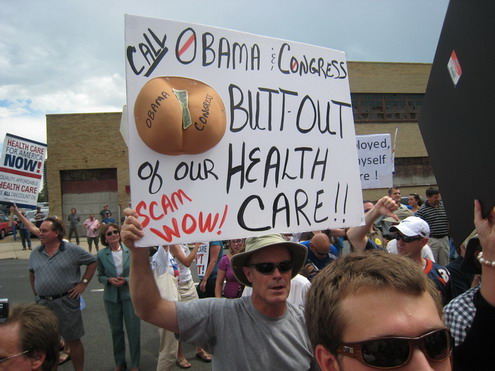
But in reality, President Obama has been almost the perfect Republican president. He signed into law an extension of the Bush tax cuts, has done (from environmentalists' perspectives) little to nothing towards tackling climate change, allowed Wall Street, Big Banks, Big Business, and corporations to generally escape from much harsher regulation, has stopped short of approving gay marriage, has continued and even enhanced Bush-era policies on civil liberties and fighting foreign wars, kept Guantanamo open, deported hundreds of thousands of illegal immigrants, vastly increased unmanned drone attacks in Pakistan and other Muslim countries (resulting in the deaths of countless innocent civilians, including children) and has been mostly hawkish in handling Iran's development of a nuclear weapon. The Obama administration's much ballyhooed economic stimulus bill contained significant portions of neo-liberal, supply-side hot air, consisting of almost 1/3 tax cuts that do almost nothing in terms of actually stimulating the economy. Taking this into account, the stimulus was fundamentally conservative in its size and content.
The President's signature health care bill, conservative apoplexy nothwithstanding, is fundamentally a right-wing policy; as recently as 2008, its concept was endorsed by such conservative stalwarts as Newt Gingrich, Mitt Romney, and Jim Demint. The chief economist that helped Republican Governor Mitt Romney of Massachusetts implement what is essentially the same bill in that state also helped the President in developing the federal version. The Obama health care bill is based entirely upon an idea created by the ultra-conservative Heritage Foundation, endorsed by multiple Republican leaders for almost 20 years prior to its embrace by Democrats, and is incredibly reliant upon the free market and private industry for its efficiency.
If President Obama had an (R) next to his name instead of a (D), conservatives would be ecstatic over his accomplishments. Judged by what he has actually done rather than what he has merely said, the President has governed in a fundamentally conservative fashion.
Voters, critics, and citizens need to judge politicians more by what they do, rather than what they say.
President Obama has said a lot of things about tackling climate change, while Prime Minister Harper has not; neither has, in the end, done very much to reverse the warming of the earth or man's impact thereupon. If the end result for both are the same, what difference then does it make that their opinions on what should be done are rather different?
President Obama has said he wants to see taxes rise (a pitiable amount) on the affluent, while Prime Minister Harper has expressly ruled that out; neither have actually raised taxes on anyone, making the President's statements (to this point) moot.

American conservatives don't like President Obama's policies mostly because he is a member of the Democratic Party - much if not most of his policies are fundamentally conservative in nature and would be applauded had they been done by a Republican administration. They are judging him more by what he has said (or what they think he will do) rather than what he has actually done.
Canadian critics of Prime Minister Harper appear as well to be judging him more based upon his party affiliation (or what they think this affiliation really means for as-yet unproduced policies) than on what he has actually done; small tax cuts, small free-trade deals, small movements to reduce the size and scope of the federal government do not by themselves constitute a fundamental remaking of the nature of Canadian society. Indeed, the Conservatives' self-stated goal is to replace the "centrist" Liberal Party; by moderating their social views and slowly implementing fiscal policies that for the most part can be agreed upon by many members of other parties, they are coming closer and closer every day to achieving this goal (the Liberals, it must be remembered, were the ones who drastically cut social spending and implemented the North American Free Trade Agreement after campaigning explicitly not to).
Canada's conservatives are not radicals - they will leave abortion and gay marriage untouched, and do nothing more than poke at the edges of reforming social legislation and welfare institutions. The Democratic Party and President Obama are also fundamentally a party of the center, with substantial overlap with the Right. Even the tax hikes they are discussing (dismissively accused of being unconscionably high) would do essentially nothing to halt or reverse the trends of income inequality. Indeed, many leading Democrats have expressed openness to massively cutting Medicare, Medicaid, and Social Security - putting these societal institutions' futures in danger.
Judging by what they do rather than what they say makes the political process less hysterical and more open to serious, frank discussion that has a greater chance in resulting in policies that benefit the majority of society; projecting one's basest fears onto parties that represent those things that one dislikes the most only serves to reverse this democratic process.


