The first thing to consider with autonomy is the historical context. Quebec's is pretty straightforward: Originally colonized by the French, the sparsely-populated northeastern part of North America was a French-speaking outpost mainly used to sell furs for the European market. As France's other colonies in the Caribbean were much more valuable, they basically gave Quebec over to the British in relief after the latter won the Seven Years' War (French and Indian War).

Quebec's geographic position in Canada
Thus, the mainly Catholic and French-speaking former colony of France became a part of the British Empire, where Anglicanism and the English language were dominant. It wasn't as bad as it sounds, though, considering that the English actually gave Quebec quite a bit of leniency in regards to their civil laws, courts, language, and religion. Sure, they were still not allowed to independently rule themselves, something which helped cause the rebellions of 1837 and 1838, but these were put down relatively easily by the ruling British. As the decades passed and British North American turned into the Dominion of Canada, things were relatively quiet on the cultural radar of Quebec.
The 1960s is when things really heated up, during the so-called "Quiet Revolution". In only two decades, Quebec transitioned into a secular and industrialized province with a rather large portion of the population advocating separation from Canada, or at the least, significantly more autonomy. The sovereigntists helped elect the new Parti Québécois to power in the province, the first time a provincial government actively advocated secession from Canada. Two referendums on the subject of whether or not Quebec should be independent (or semi-independent), one in 1980 and one in 1995, both rejected outright independence, albeit by merely a whisker in 1995.
 The Sudetenland's tale is quite different than Quebec's. Most people learn about the Sudetenland when studying the origins of World War II, in which the mainly German-speaking part of Czechoslovakia was willingly handed over to Hitler by the Allies in exchange for peace in 1938. The story behind the Munich Conference is, however, much more complex than this simple rendition shows.
The term Sudetenland didn't even come into usage until the 1930s, and was only then used as a way of differentiating German-speaking Bohemians from Czech-speaking ones. The history of Germans and Czechs in Bohemia goes back centuries, as ethnic Germans began settling on Bohemian crown lands around 1100. The two groups generally lived in harmony over time, though they did indeed have separate existences, divided into their own ethno-cultural groups. But Bohemia was included in first the Holy Roman Empire of the German Nation, then the Habsburg Monarchy, in which the German language and culture was accorded the highest status. To be non-German or speak a Slavic tongue meant to be backwards, a peasant, uncultured. Until the 19th century, Germans considered Bohemia and Prague as German as Bavaria and Munich.
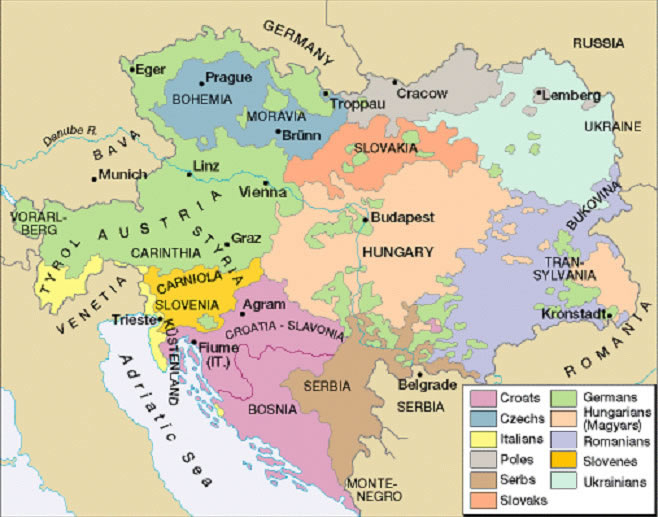
Problems only really began to arise when nationalism was awakened in the Slavic peoples of East and Central Europe, who resented the condescension and privileges awarded to the smaller German group. As the Empire became more liberal and allowed greater freedoms to its constituents, the balance of power among Germans and Czechs began to drastically change from a German position of power to that of the Czechs.
Beginning in the 1850s and carrying through to the start of World War I, Czechs slowly began to award themselves more privileges and powers previously given only to Germans, causing both Czech and German nationalism to rise in competition. With the influx of nationalism, what would otherwise have been normal democratizations of daily life became battles in a struggle of "nations"; the reduction of German-language schools was seen as catastrophic, the question of an official language provoked heated debate, and tempers on both sides came to a breaking point.
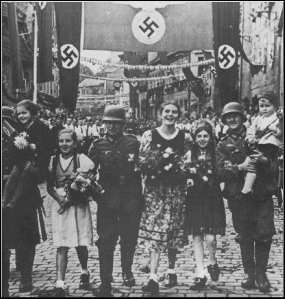
World War I postponed a possible violent destruction of the Habsburg Monarchy, but the war's aftermath wasn't very acceptable to German-speakers either. Despite plebiscites held that declared German-Bohemian desire to join the new Austrian or German Republics, the Allies unilaterally declared the eastern rim of Czechoslovakia that was called the Sudetenland to remain under Czech control. The central government in Prague then ruled over some three and a half million Germans who did not desire to be a minority in a Slavic state.
 The questions with which to be concerned are now: Is/were the minority justified in wanting more autonomy? In what way did/do the majority deal with the question of autonomy in regards to their minority? How were the situations of the Sudeten Germans and Francophone Canadians similar or different?
For both cases, both French-speaking Quebeckers and German-speaking Bohemians were justified in wanting some form of autonomy, but a better question would be as to how much autonomy they should be granted. Similar complaints from both groups were that they were underrepresented in the civil service, their language was not regarded in the same way as the majority's, and they both felt at least slightly oppressed. The major difference that enabled Quebec to peacefully remain part of Canada and allowed the fascist dictatorship in Germany to annex the Sudetenland was in how the federal government responded to calls for autonomy.
In Canada, French became an official language, the national flag got rid of any British sentiment, the national anthem is sung in both languages, and some accommodations were made to promote bilingualism, equality, and justice for both Anglophones and Francophones. Being a Canadian province means that Quebec is somewhat independent, having their own government and premier. As well, despite the rise of sovereigntist parties in Quebec, there was always still the option of voting for federal parties that were open to every province and every person, regardless of language or ethnicity. With the Meech Lake Accord and the Charlottetown Accord, Francophones could at least perceive that the government was making an effort to achieve some kind of balance, even if this attempt was ultimately dissatisfying and unsuccessful.
Notwithstanding the rather stark contrasts in the geo-political situations facing Canada and Central Europe in the 1930s, the central government in Prague made some major mistakes in attempting to deal with the issue of autonomy. In Czechoslovakia, the Germans were not the only ones who desired some form of autonomy; there were many Slovakians who also wanted to be free of what they saw as Czech dominance, as well as thousands of Poles, Ruthenians, and Hungarians. The problem with the First Czechoslovak Republic was that its leaders saw it as a nation-state, when in actuality it was 50% non-Czech. The national flag reflected on Czech and Slovak cultures; passports were in "Czechoslovak" and French only; coins, stamps, and other minutiae of daily life were only in Czech or presented Czech nationalist images; even political parties were divided along ethnic lines, meaning that a German in Bohemia could not vote for any party but the ethnically German ones. There was no "Bohemian Party" that was open to every ethnicity. There were no provincial parliaments in Czechoslovakia, meaning that the fervent German desire to at least partly govern themselves went unfulfilled. In Czechoslovakia's case, the German's perception was that they were unfairly persecuted and ignored because of their Germanness; this perception led to an opportunity for the National Socialist regime to exploit the situation, which they did with great aplomb.
Though calls for sovereignty or independence for Quebec have recently quieted down, the continuing strong showings of the Bloc Québécois and Parti Québécois demonstrate it still is an issue. When compared with the situation of the Sudeten Germans and Czechoslovakia - an experience that saw fascism, murder, and expulsion -, French-Canadians can count themselves lucky and fortunate to live in the tolerant, responsible, and open-minded country that they do.


