Showing posts with label conservatism. Show all posts

Monday, March 26, 2012

When Have Conservatives Been on the Right Side of History?

Corey Robin has recently wrote a book called The Reactionary Mind, which seeks to trace the continuities and fundamental attributes of political conservatism throughout the centuries and among a range of prominent people, from Edmund Burke to Sarah Palin. One of the major themes to be drawn from his analysis is that the fundamental essence of conservatism, everywhere and in every period, is the defense of privilege.

If this is true, it does much to explain the conservative argument, no matter the context or time period. Defense of privilege equates to defense of the wealthy, defense of businesses, defense of males, defense of whiteness, and so on.

If conservatives have consistently been on the side of the haves and not the have nots, then when have they been on the right side of history?

Currently, mainstream conservatives are against gay marriage, minority rights, and universal healthcare, while they are also skeptical of the merits of climate change, renewable energy, and electoral reform - things that will in the not-too-distant future be looked back upon by bewildered young people as being backwards, obtuse, and reactionary.

But conservatives were also against things that are now perceived as abominable: they went to great lengths to preserve slavery, then later to protect segregation and fought to keep policies that benefited minorites, such as the Voting Rights Act and Affirmative Action, from being implemented; conservatives were against women's suffrage, against most laws that benefited organized labor that we now take for granted (minimum wage laws, over-time pay, the 40-hour work week, paid vacation, etc.), have consistently been against immigration or anything that threatened white, affluent, heterosexual, Protestant males in general.

The major policies in the United States that have benefited the vast majority of society and helped to create a more tolerant, more equal society have in the past 80 years come exclusively from liberals and progressives, such as Medicare, Medicaid, and Social Security. Even the laws that a Republican president signed into law, such as the Clean Air Act under Richard Nixon, have come about only when the Democratic Party controlled both houses of Congress.

In Europe, conservatives historically were vehemently mobilized against the vast majority of society that was not an aristocratic, white, Christian male and had no qualms about justifying the use of violence to repress movements that sought to promote voting rights, minority rights, and increases in democracy.

If mainstream conservatives, conservative thought, and conservatism as a political movement in general have consistently been on the side of privilege, then they have also consistently been on the wrong side of history. But this does not mean that they have never been on the right side.

Conservatives in Europe were correct about totalitarianism, whether in its fascist or communist variant. Though Neville Chamberlain, as a Conservative Prime Minister, pursued a policy of appeasement in dealing with Adolf Hitler's Third Reich, this was controversial even among his own party. The man who succeeded him, Sir Winston Churchill, was a consistently vocal and aggressive opponent of fascism. Later, when many on the Left had become enamored and apologized for the violent excesses of the Soviet Union, Churchill and conservatives called it what it was - totalitarian. Of course, French and British conservatives both supported the maintenance of imperialism (though they went about its decline in different ways).

Edmund Burke and other conservatives did not just protest against the French Revolution, they believed it to be a terrible idea. Indeed, their warnings in the early stages seemed especially prescient after the country descended into wide-ranging pandemonium, with citizens being indiscriminately murdered and movements such as The Terror and the Committee for Public Safety emerging. Napoleon Bonaparte may have introduced certain "progressive" reforms onto the Continent, but European conservatives decried his reign for what it was - a tyrannical dictatorship.

While those on the Left have had their fair share of poor decisions - supporting Mao's overseeing the starvation of millions in China, for example - conservatism has much more often than not been on the wrong side of history. Even when they have been correct, such as when confronting the French Revolution, the rise of totalitarian communism, and fascism, conservatives have also had a tendency to go overboard in their zeal - see Joseph McCarthy's fanatical rants about communist subversion or the appalling record of imprisoned minorities that have resulted from conservative crime laws.

If, as Dr. Martin Luther King said, the arc of moral universe bends towards justice, then it is not due to conservatism that it is being bent that way.

Wednesday, February 22, 2012

Judge Others by What They Do, Not What They Say

A few weeks before the 2011 Canadian federal election, Heather Mallick wrote an opinion piece in the Toronto Star titled "What if the Harper Government were to win a majority?" In it, she accuses the Conservative Party and Prime Minister Harper of being serial liars and hypocrites. In her hypothetical political apocalypse of a world where the Conservatives were to win the upcoming election, she predicted that "old-tyme religion will reign", "students would turn [professors] in for Wrongspeak and [they] would lose [their] job", and accused conservative ideology of "working for" a societal structure that leaves massive amounts of poor and unemployed. In her long list of atrocious policies she imagined the hypothetical Conservative majority would implement, she referred to the Prime Minister's treatment of his "enemies" as "Stalinist", while confidently asserting that

"Canada would increasingly resemble the U.S., a model that makes European countries shudder. Guns on the street, gated communities, rampant drug use, unlimited anonymous corporate political donations, no government safety standards for food and medicine, classrooms that resemble holding pens more than civilized safe rooms for the young to learn . . . If Harper got his majority, these things would hit us like an avalanche.

Citizens regarded as 'ethnics' would be courted until election day, and then abandoned. Forget family reunification, forget federal money to ease non-whites' path into Canadian society, forget English classes.

Women's rights would retreat, including abortion rights, access to medical advances and the right to go to court to protest inequality.

Everything would be up for privatization, from roads, parks and parking meters to schools and hospitals."


From Mallick's perspective, one would think of the Conservatives as reactionary, chauvinist, ultra-libertarian racists who would fundamentally dismantle Canada's hitherto existing society and reshape it into some kind of horrible arch-conservative dreamworld.

What would make someone so afraid of a Conservative majority that they would imagine such a world? What did the Conservatives do while forming a minority-government to make Heather Mallick so hysterical?

It seems that, rather than basing her opinions and predictions on what the Conservatives had actually done while forming the government, she based them on certain things they may have said or what she feared they might do - with no strong grounding in facts.

Nothing in what the Conservative Party had done up to then would have made her believe that "old-tyme religion" would reign, or that abortion rights would be repealed, gay marriage abolished, or anything else that she so fervently fear-mongered. Any reasonable, non-partisan person who assessed the Conservatives' platform and their previous policies would know that they would never introduce such reactionary social legislation, because it would mean the death of their mandate. Canada is, after all, a country that is leans left on social issues but is more fiscally conservative - the Conservative Party had done its best over the years to mold itself to fit into this niche.

This is not to say that the Conservatives had been completely centrist and pragmatic in their years of minority-government; they had enacted some rather minor tax cuts, business tax breaks, and a few pieces of "red meat" for their base - reforming the long-form census and purchasing some fighter jets. But what seems to be utterly incomprehensible to Mallick is that none of these things could have happened without other parties voting for them due to the minority-ness of the Conservatives' government - including her beloved Liberal Party. Even when the Conservatives did commit a truly anti-democratic act - the prorogation of Parliament before the 2010 Winter Olympics in Vancouver - as much blame should be apportioned to the Governor-General for accepting the Prime Minister's request. The electorate as well clearly didn't think much of the other parties voting to censure the Conservatives, as their percent of electoral support only increased from the previous election.

In short, it appears that Mallick was judging the Conservatives by their words (or what she assumed was their nefarious, secret plan ensconced in their ideological id) rather than their actions. Their words may sometimes mark them out for being more ideologically on the Right, while their actions - for the most part - suggested that they much more often than not took the centrist approach to politics rather than a hard right one. [This may all change, as the Conservatives did indeed win a majority after the 2011 election and now have no need to court the votes of other parties in Parliament]

While non-conservatives in Canada may fear and imagine the worst from their newly-elected government, American conservatives have spent the last several years warning anyone who would listen of the "radicalness" of the Obama administration. The National Rifle Association, for example, has claimed that the President is merely biding his time for after the 2012 election to completely ban guns and abrogate the 2nd Amendment (the fiend!). They believe this, despite literally no factual policies or quotations from the administration, and after a United States Congresswoman was shot in the head by someone, and after the only policy that Obama has implemented with regards to gun control actually expanded Americans' 2nd Amendment rights.

American conservatives, just like Canadian non-conservatives, seem to be judging the President by what they think he will do, based upon what he has said rather than done.

If President Obama's statements were to become the laws that he actually signed, then conservatives may have something to dislike: he says that he favors higher taxes on the rich, stronger regulation for Wall Street, less loopholes for corporations, comprehensive immigration reform, strong action to tackle climate change, and advocates tolerance for religious and sexual minorities like Muslims and gay people. He also, as a presidential candidate, said that he would close Guantanamo Bay, end torture, end the wars in Afghanistan and Iraq, implement universal health care (while opposing an individual mandate) and generally reverse the violations of civil liberties undertaken by the Bush administration.

But in reality, President Obama has been almost the perfect Republican president. He signed into law an extension of the Bush tax cuts, has done (from environmentalists' perspectives) little to nothing towards tackling climate change, allowed Wall Street, Big Banks, Big Business, and corporations to generally escape from much harsher regulation, has stopped short of approving gay marriage, has continued and even enhanced Bush-era policies on civil liberties and fighting foreign wars, kept Guantanamo open, deported hundreds of thousands of illegal immigrants, vastly increased unmanned drone attacks in Pakistan and other Muslim countries (resulting in the deaths of countless innocent civilians, including children) and has been mostly hawkish in handling Iran's development of a nuclear weapon. The Obama administration's much ballyhooed economic stimulus bill contained significant portions of neo-liberal, supply-side hot air, consisting of almost 1/3 tax cuts that do almost nothing in terms of actually stimulating the economy. Taking this into account, the stimulus was fundamentally conservative in its size and content.

The President's signature health care bill, conservative apoplexy nothwithstanding, is fundamentally a right-wing policy; as recently as 2008, its concept was endorsed by such conservative stalwarts as Newt Gingrich, Mitt Romney, and Jim Demint. The chief economist that helped Republican Governor Mitt Romney of Massachusetts implement what is essentially the same bill in that state also helped the President in developing the federal version. The Obama health care bill is based entirely upon an idea created by the ultra-conservative Heritage Foundation, endorsed by multiple Republican leaders for almost 20 years prior to its embrace by Democrats, and is incredibly reliant upon the free market and private industry for its efficiency.

If President Obama had an (R) next to his name instead of a (D), conservatives would be ecstatic over his accomplishments. Judged by what he has actually done rather than what he has merely said, the President has governed in a fundamentally conservative fashion.

Voters, critics, and citizens need to judge politicians more by what they do, rather than what they say.

President Obama has said a lot of things about tackling climate change, while Prime Minister Harper has not; neither has, in the end, done very much to reverse the warming of the earth or man's impact thereupon. If the end result for both are the same, what difference then does it make that their opinions on what should be done are rather different?

President Obama has said he wants to see taxes rise (a pitiable amount) on the affluent, while Prime Minister Harper has expressly ruled that out; neither have actually raised taxes on anyone, making the President's statements (to this point) moot.

American conservatives don't like President Obama's policies mostly because he is a member of the Democratic Party - much if not most of his policies are fundamentally conservative in nature and would be applauded had they been done by a Republican administration. They are judging him more by what he has said (or what they think he will do) rather than what he has actually done.

Canadian critics of Prime Minister Harper appear as well to be judging him more based upon his party affiliation (or what they think this affiliation really means for as-yet unproduced policies) than on what he has actually done; small tax cuts, small free-trade deals, small movements to reduce the size and scope of the federal government do not by themselves constitute a fundamental remaking of the nature of Canadian society. Indeed, the Conservatives' self-stated goal is to replace the "centrist" Liberal Party; by moderating their social views and slowly implementing fiscal policies that for the most part can be agreed upon by many members of other parties, they are coming closer and closer every day to achieving this goal (the Liberals, it must be remembered, were the ones who drastically cut social spending and implemented the North American Free Trade Agreement after campaigning explicitly not to).

Canada's conservatives are not radicals - they will leave abortion and gay marriage untouched, and do nothing more than poke at the edges of reforming social legislation and welfare institutions. The Democratic Party and President Obama are also fundamentally a party of the center, with substantial overlap with the Right. Even the tax hikes they are discussing (dismissively accused of being unconscionably high) would do essentially nothing to halt or reverse the trends of income inequality. Indeed, many leading Democrats have expressed openness to massively cutting Medicare, Medicaid, and Social Security - putting these societal institutions' futures in danger.

Judging by what they do rather than what they say makes the political process less hysterical and more open to serious, frank discussion that has a greater chance in resulting in policies that benefit the majority of society; projecting one's basest fears onto parties that represent those things that one dislikes the most only serves to reverse this democratic process.

Tuesday, December 20, 2011

The Difference Between Two Parties, Part II

In an earlier post, it was made clear that the Republican and Democratic Parties have clearly-delineated differences between them that separate the two. Though there are still many aspects of the two that are more or less the same - witness President Obama's continuation of Bush-era foreign policy as a good example - there are nonetheless fundamental differences at the core of each party.

One of these core, fundamental differences lies in each party's base. A party's base is the soul of the party. They are the ones who will support the party above all else, who strive to make it the best it can be. The ones who are among the very low percentage of Americans who vote in primaries or non-Presidential election years. The ones who are the most rigidly ideological - conservative or liberal. The base pushes the party either more to the Right or more to the Left, depending on how far the party strays.

It is common knowledge that both parties are actually composed of several factions that together combine to make up a coalition of moderate-to-center-right and moderate-to-center-left organized political bodies. History has shown this to be the case for much of the last 100 years, with most policy being compromises that end up squarely in the middle of the political spectrum.

This common knowledge is, however, completely false. Two moderate, pragmatic American political machines, one center-left and one center-right, have not existed as such for at least 40 years, if not longer. Much of this is due to the increasingly right-ward drift of the Republican Party, whose conservative wing now composes the majority of members and for all intents and purposes is the party. There are barely any liberal Republicans any more, and moderate Republicans have mostly been purged.

With the Republican Revolution in the mid-1990s, when they took control of the House for the first time in over 40 years, the party's conservative wing had finally won an enormous victory (if you discount the 12 years of Presidents Reagan and Bush). This was followed up by the eight-year reign of President George W. Bush and a Republican Congress, who managed to spectacularly fail in essentially every single thing they did. Such failure was always going to happen because the Republican Party had become a party of fanatical ideologues whose only goal it was to enact their pet conservative policies, regardless of whether these policies worked.

Decades of right-wing economic policies and many socially-conservative victories in Congress have substantially shifted the country to the Right. The United States is now one of the most unequal industrialized countries in the world, while also managing to be the lowest-taxed, least-regulated, and most-dependent upon fossil fuels. It is a country in which it has become increasingly complex and difficult to get an abortion, receive already scanty unemployment benefits, but where it is spectacularly easy to purchase and carry a firearm in public.

The immense failure of the Right's policies can be seen in the explosion of the deficit, the racking up of enormous amounts of debt, engaging in two illegal, unfunded wars that have resulted in the deaths of hundreds of thousands and severely tarnished the nation's reputation abroad, the absolute financial collapse of Wall Street which nearly completely ruined the U.S. economy, and allowed health care costs to rise unaccountably high due to intense opposition to the one thing is known to bring it down - some form of universal, single-payer coverage.

That this failure of conservative ideology has resulted not only in denial of its failings, but in a doubling down of voting in even more conservative conservatives is rather astonishing. But it speaks to the power of the Republican Party's base, and how the party itself caters to it. Republican office-holders will do anything, anything, to appease their base. They will pledge to destroy the economy unless taxes are not raised. They will stand on principle to oppose a health care bill that will lower costs. They will go back on literally anything they have said in the past that might compromise them now - Orwell would be nodding his head - all in order to appease their base. They will do all this because they are absolutely terrified of their base. And they have good reason to be. Republican primary voters have shown that they will not tolerate those who they consider to be insufficiently conservative. So, Republicans constantly harangue each other as to who is the most conservative, who is the true conservative, etc. They do this not only because they have to, but because being conservative is a good thing.

In contrast to the Republican Party's base, the Democratic Party hates their base. With a passion. It should be noted that, though Democrats are usually thought of as "liberals", most Democrats are not self-identified liberals. A plurality of Democrats are liberal, with many moderates and a substantial amount of conservatives. The Democratic Party, then, still embodies the old notion of a center-left coalition. Even though most moderates share almost every single belief that liberals do, "moderate" Democratic politicians often find themselves ostracizing their liberal colleagues. This has resulted in many moderate and conservative Democrats embracing right-wing, conservative, Republican policies that have truly been terrible for the country. As a result, national policies have skewed to the Right for several decades.

Whenever there is a complaint about this rightward drift from the Democratic Party's base - that is, from liberals - the "mainstream", "moderate" Democratic politicians like to push back against them to prove how "serious" they are. Liberals are branded as "extremists" and their complaints are not accepted. And they can do this because they know that nothing will happen to them. Nothing at all. Whereas Republicans are terrified of their base, Democrats hate their base. Democrats will not vote out a politician for not being liberal enough or for doing something that the Democratic Party does not stand for.

How many Democrats lost their primaries to more liberal politicians after voting for the War in Iraq? How many Democrats lost their seats after voting for the Bush tax cuts, or for cutting welfare, or for supporting de-regulation. or for passing the PATRIOT Act, or for voting against gay marriage, or anything else that went directly against liberal principles? The Congressional Progressive Caucus did not stand as a group and vote down the Affordable Health Care Act for not providing a public option or single-payer mechanism like the Tea Party Republicans almost certainly would have done (though this may or may not have been a good thing).

While Republican presidential candidates argue about who is more conservative, you would be very hard-pressed to get a Democratic candidate to admit that they are liberals. Being liberal is a bad thing, you see. It means you aren't "serious", that you are "out of touch". Of course, being conservative means exactly the opposite. This hesitancy to embrace liberalism and the corresponding "hippie-punching" that the Democratic Party regularly engages in with its base is due to the acceptance of the status-quo by liberal party members who do not vote with their principles. By accepting the Democratic Party's embrace of illegal wars, illegal torture, deregulation, unconstitutional surveillance activities, interventionist, warmongering foreign policies, liberals are accepting the status-quo. By not voting to change policies to fit their own values, like conservatives do, liberals allow the American political spectrum to shift to the Right. Inevitably this leads to compromise between the center-right and the Right. This is a terrible choice that inevitably also leads to terrible policies.

Therein lies another major difference between the two parties. Republicans are afraid of their base, while Democrats hate theirs. This divergence among the die-hard ideologues of both parties has resulted in creating a shadow United States, one that is somehow still a superpower but that also is only a fraction of the greatness it has the potential to be. One way to shift the dialogue, shift the spectrum, shift the nature of policies, is for liberal Democrats to gain a voice, stand up, and vote their conscience. They must make the Democratic Party responsible and accountable. They must return the party to its core whence it has for several decades been fleeing.

Thursday, October 13, 2011

The Puzzling Triumph of Right-Wing Economics

In the decades following the end of World War Two, industrialized countries' embraced left-wing socio-political concepts and embarked upon ambitious social-democratic agendas: taxes on the wealthy rose, unions grew larger and stronger, things like health care and education became universalized, and in many cases large segments of the economy - like banking, natural resources, transportation, etc. - were put under control of the state, or at least regulated fairly rigorously.

In the United States, Harry Truman's Fair Deal and Lyndon Johnson's expansion of the welfare state and Civil Rights legislation led to the longest, most sustained economic boom in the nation's history. At a time when taxes on the wealthy were the highest they'd ever been, union strength was stronger than ever, America was the most prosperous. wealthiest country in the world. This prosperity was largely shared by everyone; wages for the top and bottom rose from 1945 to 1970, and the middle class was robust.

European countries, notably Scandinavia, Germany, France, and Britain, also experienced huge economic growth. Britain's Labour Party enacted universal health care and created a large social safety net, while taking control of the coal and railroad industries for public use. Social-Democratic parties in Scandinavia were almost always in power, and they used the post-war economic boom to ensure that all of their citizens would enjoy free and universal health care, education, strong labor laws that created high-paying, stable jobs and lasting, well-endowed pensions.

At the expense of the wealthiest citizens and big businesses, and to the chagrin of economic liberals and corporations, the vast majority of society in these countries were able to enjoy some of the best years of prosperity that Europe and North America had not seen for decades.

But then in 1970s and 1980s, things changed; the public sector was deemed too large, deficits too severe to maintain such a system. These countries' governments were too large and clunky to be competitive in an international marketplace. The tax burden was too high, unions had too much power, and business was being stifled by burdensome regulation.

The answer, said conservatives and the Right, was to radically alter the economy from a socialist-inspired, leftist, closed economy to one that would promote "liberty" and "freedom".

Low taxes, low spending, privatization, deregulation, weakening of unions, free-trade, free-markets, reduced pensions and benefits: these were the solutions to the terrible problems Keynesian and left-wing economics had produced over the past 30 years.

So the shackles came off. Business was unleashed, and economic freedom was pursued so that all could enjoy the prosperity that was sure to come.

Led by neoliberals like Margaret Thatcher and Ronald Reagan, massive tax cuts were enacted, coupled with privatization of formerly-state industries and the reduction in the power of unions. Free-trade deals were signed, banks, businesses, and corporations saw their regulations shredded.

In the United States, Wall Street was treated with a "hands-off" approach, culminating in the efforts of Democratic President Bill Clinton, who repealed the New Deal-era banking regulations that had largely averted massive economic crises. Corporate taxes were lowered to foster competition. Capital gains were taxed at a lower rate so that investment could grow. President George W. Bush enacted two of the most massive tax cuts in the history of the country at a time when the U.S. had experienced its first few years of budget surpluses in decades.

The result of all these policies, with all the wishes and promises of the Right, has been a complete and utter failure. Deregulation of the financial sector directly led to the most morally indignant, self-induced, criminal economic crises since the Great Depression - to the cost of trillions upon trillions of taxpayer money and the loss of millions of jobs.

While corporate profits have soared, the average wage for middle-class Americans has barely moved. Income inequality is at the highest its been for 80 years, and millions of citizens are in poverty. Unions have become decimated, but this has not led to any kind of stability in the private sector, or a reduction in budget deficits either at the state or federal level. Thousands of Americans die every year because they cannot afford health insurance to pay for the care they need. Yet the chances of the U.S. receiving a universal health care system any time in the near future is incredibly low.

In Britain, Margaret Thatcher's anti-union, pro-free-market, neoliberal reforms massively increased inequality. Tony Blair's "Third Way" economic policies did nothing to correct this, despite being a part of a Labour government that was supposed to work in the interests of the working class.

Germany's Social Democratic Party enacted right-wing labor market reforms that were supposed to halve unemployment; while unemployment did go down, millions of people now work full-time but don't earn enough money to live out of poverty and millions more are forced to receive welfare - the exact opposite of what the SPD had said would happen.

Since the end of the colonial era, many African, Latin American, and South American countries have been desperately short of cash with which to spur their economy, build infrastructure, and develop their state. In stepped organizations like the IMF and the World Bank, who loaned millions and billions of dollars to these countries, but only on the condition that they enact neoliberal reforms. The result has been crippling, unfair, immoral debt for many Third World countries; free-trade has allowed multinational corporations to take profits from those developing countries and deprive African peoples' natural resources from them; a shocking and indefensible transfer of wealth from the poorest countries on earth to the richest ones has taken place.

Now that the utter failure of right-wing economics has been exposed - and by almost all measures, they have not worked the way they were promised to -, and with the world economy laying in ruins because of these policies, almost every single government in the industrialized world is sticking with their neoliberal economic paradigm. Even supposed Social-democratic parties have almost entirely embraced this right-wing system, becoming increasingly less of a truly viable alternative to mainstream conservative parties.

It seems as though, in the face of this failure, industrialized countries are doubling down on the veracity of this narrative. People like British Prime Minister David Cameron and conservative parties like the Republicans in the U.S. are acting as though government spending and huge budget deficits caused this financial crisis, when they are largely simply the result. In order to fix the mess that neoliberal, right-wing economic policies created, the solution is to do even more of them!

So it is that millions of people must face severe, draconian cuts in social spending - there goes health care, pension benefits, education funding, and infrastructure improvements. They are told that they must d0 more with less, because....well, because they just have to.

But why must the only answer be austerity? Why is the "natural" solution to reduce government, to reduce unions, to reduce pensions, to reduce spending? How is it, that after such an obvious and upsetting upbraid to the dogmatic mantra of economic liberalism, that right-wing economic policies are not only being implemented, but are the only types of policies even seriously being discussed?

No one is forcing David Cameron's Conservative Party to proceed on the course they are; they simply have different priorities about how to proceed with governing the country.

That is essentially it: a matter of priorities. For 35 years, European and American governments have been run by financial elites, businessmen, and members of a peculiarly fiscally conservative clique who have enacted policies that their ideology tells them will benefit everyone. It hasn't worked, and only a small percentage of society has benefited; of course, those who enacted these policies just so happen to also be the ones who have benefited the most.

This group is telling society that these cuts, these policies, will be painful but must take place and will eventually pay off. But why does the pain have to be felt by those who least deserve to feel it?

Would it be just as painful to end corporate welfare? To close tax loopholes? To strengthen labor unions? To enhance the safety net? It would be - but for different people. And that is all the difference. As long as the industrial economy's engine is the corporation and Big Business, so too will fiscal policies be neoliberal and inadequate. Growth will be slow, life will be harder for most people, but everyone will be told it is the only way.

But it doesn't have to be.

Friday, September 16, 2011

Republicans are Authoritarian Corporate Fascists

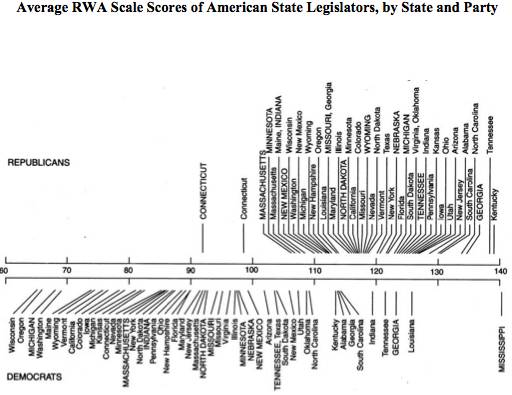
Professor Bob Altemeyer from the University of Manitoba in Winnipeg, Canada, has spent several decades scientifically studying authoritarianism. The findings of his life's work were published in the 2006 book The Authoritarians, and is available in its entirety for free.

What he has through his years of research discovered - who authoritarian followers are, what their characteristics are, how they act, how they think, why they think and act the way they do - explains the roots of fascism and authoritarianism in a way that many will find helpful. His conclusions also describe the current state of the Republican Party and most of its followers.

Altemeyer's research deals mostly with the followers of authoritarians; those who submit to their authorities. Right-wing authoritarians show a high degree of submission to the perceived legitimate authority figures in their society, high levels of aggression in the name of their authorities, and are highly conventional, adhering to traditions and social norms endorsed by society and authority figures while believing that the rest of society should as well. Most right-wing authoritarians are conservative, though they can also be politically on the left (think Stalinist-era Communist Party cadres).

The Right-wing Authoritarian Scale has been developed to determine how authoritarian a person is. Most people who take the test admit to a certain amount of submissiveness to authorities: people follow traffic laws, for example. Right-wing authoritarians, however, submit on a far greater scale, and will do so regardless of whether what their leader is doing is evil, corrupt, undemocratic, unprincipled, or dishonest. Conservatives and Republicans tend to scale much, much higher on this scale than most other Americans. Republicans, no matter where they were from or at what level of government, were much less diverse in their responses than Democrats.


Right-wing authoritarians display high levels of hostility towards any "out groups" that their authorities tell them they are against (an "us versus them" mentality); this can be seen in Republicans' marked anti-homosexuality stance, fervent anti-immigrant and anti-minority legislations, and their religious devotion to the Constitution - which does not stop them from curtailing sacred and inalienable rights with policies such as the PATRIOT Act.

This hostility towards the out group is also remarkable in that they approve of authorities who attack members of the out group, despite any crimes the authority figure may have committed. People showing this trait are also unable to display normal levels of empathy, to "go a mile in someone else's shoes" - Republicans have no sympathy for those who have fallen on bad times through no fault of their own and are virulently against any form of universal health care.

Right-wing authoritarians share a strong sense of group loyalty and cohesion, are more likely to be fundamentally religious (thereby also being extremely prejudiced), trust leaders who cannot and should not be trusted despite evidence to the contrary (Richard Nixon, George W. Bush), do not hold authority figures accountable for crimes, and accept illegal abuses of power by government authorities (the PATRIOT Act, legislation discriminating against minorities and immigrants).

Authoritarians cannot draw logical conclusions based on evidence. They hold many contradictory ideas at the same time in their head, use double standards, accept insufficient evidence to support their beliefs, and believe fully without questioning what their leaders tell them.

Authoritarians are dogmatic, hypocritical, oppressors who abuse their power when they have it to dominate others and inflame inter-group conflict. They are self-righteous, do no believe in any of their own failings, and embrace religion as a way of masking their guilt while sustaining this self-righteousness.

All of these traits of authoritarianism can be seen in the modern Republican Party and their followers.

Authoritarian conservatives believed more firmly and for a longer time than most other Americans the egregious lies that the Bush administration spread about Saddam Hussein's connections to the September 11 terrorist attacks and the existence of weapons of mass destruction in Iraq.

Republicans claim to believe in small government and the Constitution, yet while in power they massively expanded the government and infringed upon the inalienable rights of millions of Americans in flagrant violation of these so-called beliefs. Though they nominally should believe in the Constitutional right that every citizen shall not be put to cruel or unusual punishment, conservatives had no problem when the Bush administration sanctioned torture, arrested citizens without trial, repealed habeas corpus, or turned the country into a police state. Conservative authoritarian followers unflinchingly followed George W. Bush, and the Republican Party single-mindedly pursued a dogmatically authoritarian track while in power.

The Republican Party and its base are constantly in fear of those who are not like them: Muslims, Blacks, immigrants, gays, atheists. They believe these "others" to have a sinister, nefarious plan to deliberately destroy the country - just see some of what they have had to say about the first president of non-European descent.

Republicans cannot accept the legitimacy of a Democratic president. Conservatives believe, because they were told so by their authorities, that Obama is a terrorist, a Muslim, that he hates America, that he is a Communist and that he used massive voter fraud and a biased media to cheat a win out of the 2008 Presidential election.

The Republican Party, its members, representatives, and most of its followers are authoritarians. The traits that distinguish them as such blend as well into fascism - an undemocratic ideology that believes in devotion to a strong leader, aggressive nationalism, suppression of others, and the right to engage in violent war to secure its safety.

Republicans are nationalistic, ethnocentric, glorify and exalt the military, reject any measure to increase equality, oppress those who are not like themselves, and stop at nothing, no matter how undemocratic, to rout their political enemies and gain power. Republican lawmakers who exhibit exceptionally high authoritarian tendencies and display one of the above-mentioned fascist ideological traits are likely to rise up through the party; the same cannot be said for Democrats.

The Republicans' hatred of democracy is well-documented:

-in the 2000 Presidential election, there were multiple cases of crimes by Republicans that effectively disenfranchised thousands of African Americans in the hotly-contested state of Florida, allowing nominee George W. Bush to be awarded the state's electoral votes by the conservative Supreme Court in an unprecedented decision that, for the first time in the entire history of the country, was told would count for this one instance;

-in 2004, Republican lawmakers held an open vote in the House of Representatives for over three hours (the mandated limit is 20 minutes) in order to threaten enough other members to vote for a bill that added billions of dollars to the national deficit;

-the democratically-elected Democratic majority in the United States Senate was unable to pass any legislation or appoint any person due to the undermining of democracy that is embodied in the filibuster as used by Republicans

-Republican-controlled state legislatures all over the country are pursuing policies that adversely affect and disenfranchise African-Americans, Latinos, students, and immigrants - all of whom tend to vote for Democrats.

-in the Republican-controlled Wisconsin state legislature, lawmakers flagrantly violated laws in order to pass an anti-union law that they did not campaign on; in the aftermath, a contest for Supreme Court was awarded to the conservative after a county clerk in a heavily-Republican district made a "mistake" in miscounting over 7,000 votes that happened to hand the victory to the Republican.

The Republican Party is the party of Watergate, Iran-Contra, Iraq, Afghanistan, McCarthyism, the PATRIOT Act, multiple sex scandals, Savings and Loans, and the Committee on Un-American Activites; the party that massively increased the nation's debt and then used it to hold the country hostage several times for partisan political gain.

The modern Republican Party cares exclusively about the corporations that run the economy and the super-rich plutocracy who benefit from their economic policies. They will do all in their power to maintain and enhance their corporate overlords, including holding the American and global economies hostage to preserve the favored status in tax brackets of the world's most well-endowed businesses and oligarchs.

Republicans have shown almost no interest in curtailing the pervasive and outrageous influence that corporate money presses upon American politics; on the contrary, they have embraced it, thereby undermining democracy even further.

This is despite clear evidence showing that the American economy was at its strongest when taxes on the rich were at their highest, savings from tax cuts are much more likely to be saved than spent by the wealthy, the United States is the least-taxed industrialized country in the world, and that corporate profits are higher than ever but they are not now and do not usually create that many jobs. But facts and evidence don't matter to the authoritarian, slavish devotion to their ideology does.

The Republican Party is a monolithic, extreme right-wing, antidemocratic, ideologically driven authoritarian, corporate, and fascist political organization.

They are not interested in governing, nor compromise. They exist solely to gain political power at any cost and to destroy their political opponents, while worsening the oppressive socio-economic power relations that keep all minorities - religious, ethnic, racial - excluded from the upper echelons of society in the richest country in the world. And they are dangerously close to gaining control of the levers of power of the richest, most powerful country in the world.
Friday, May 20, 2011

The Difference Between Two Parties

American politics is rather unique. One of the major differences between the United States and other countries is the entrenched position of the two major parties, something which has lasted for decades and likely will continue to do so. Being a country that essentially only has two parties, one would expect there to be pretty big gulfs in ideology, policies, etc., so as to give voters a clear choice. Though there are some pretty big differences to be found among the average Republican and Democrat, many things are actually quite similar.

In his 1948 book, titled The American Political Tradition, historian Richard Hofstadter argued that the American presidency had always maintained two major themes, no matter the ideology or party affiliation of the president. Those two currents of American politics were capitalism and nationalism - something which Hofstadter saw in every administration up to his time, and which can still be seen in many instances through to the present day.

Democrats and Republicans often have narrow debates, not really arguing about the proverbial where so much as the how. For example, the current big issue enveloping the American political world is how to reduce the deficit and how deep spending cuts should go, instead of whether the deficit is something to be concerned with right now or whether spending should be cut at all.

It is obvious, therefore, that the American two-party system tends to narrow the political debate in ways that are not really seen in other multi-party democracies. Nonetheless, there do remain certain important ways that can be seen separating the two parties.

The biggest difference between the Democratic and Republican party is their approach to governing. Democrats tend to try to at least seriously tackle important issues of the day in an attempt to responsibly govern, whereas Republicans maintain an ideological chain that renders them invariably lusting after political power when in the minority and chasing unrealistic far-right policies when in the majority.

Take a look at the recent 4-year period when the Democrats controlled Congress and the 2-year period when they also had Presidency. If one looks at the wish-list of the liberal base that Democrats are alleged to represent with the actual policy outcomes, the two are not even close.

The Democrats were unable to pass any significant environmental or climate-change legislation. They did not pass a gay-marriage bill, and only managed to repeal Don't Ask-Don't Tell during the lame-duck session of Congress when no one had to care about being reelected. The District of Columbia remains a district and not a state, though by doing so it would have tremendously helped their own party. Capital punishment is still legal, the PATRIOT Act was renewed, more soldiers were sent to Afghanistan, universal health care remains a pipe dream, the minimum wage is still insufficient, the richest Americans remain taxed at the same percent they were under President Bush, Wall Street remains largely unregulated, no substantial immigration bill was passed, and on and on.

For liberal and left-leaning Americans, the period of Democratic control can only be seen as mostly glass half-full, if not worse. Part of the reason why such liberal desires went unfulfilled was because of the opposition of Republicans, but also because there were more pressing matters to attend to, like trying to save the economy. A lot of bills were also watered-down by compromises with Republicans, who abused their Senatorial privilege of the filibuster. But the least that can be said about the Democratic Congress was that they sincerely tried to govern in the best interests of most of the American people most of the time.

Compare that to the 6-year period when Republicans controlled every level of government and with the recently-elected Republican majorities and governorships in many states.

The Republican mantra of low taxes and high military spending led the country to two ill-led wars of questionable legality, both decisions of which are the major reasons why the national debt was increased by several trillion dollars under a so-called fiscally responsible party. Republican distaste of alleged "Big Government" led to the appointments to the heads of federal departments people who were incompetent or had a direct, monetary stake in not regulating what they were supposed to regulate. See the federal government's response to Hurricane Katrina to see how that turned out.

Now that Republicans control several state legislatures in addition to those states' governorships, the Republican party's hatred of abortion is resulting in the most severe attacks on women's rights in recent memory. Republicans' populist dislike of immigrants and people of color has seen neo-fascist immigration laws springing up in places like Utah and Arizona. In the name of fiscal responsibility, Republicans have nakedly attempted to destroy cherished liberal and Democratic-supported institutions by enacting massive spending cuts of programs they don't like - regardless of their usefulness - and stripping public unions - who tend to get Democrats elected - of their basic function as a societal institution. Though many of the policies are unpopular and idiotic -see the fraudulent Paul Ryan budget plan laughingly called the "Path to Prosperity" that privatizes Medicare while enacting even more huge tax cuts for the wealthiest Americans - Republicans remain steadfast in their wishes, no matter how far away in fantasy-land such proposals may be.

That is the difference between two parties.

One may make mistakes and anger their core supporters through compromise in an attempt to responsibly govern while the other maintains a rigid ideology at all times, no matter what the circumstances may call for, in an everlasting attempt to seize or maintain political power. See, for example, the time at any point in which the Republican party has been okay with current tax levels, the EPA, corporate taxes, regulation, etc. This mindset, in which a certain set of policies are favored no matter the circumstances, is what MIT economist David Autor calls "now-more-than-everism", and its pervasive, often deleterious effects can clearly be seen at all times within the right-wing gong show that incorporates one of the two major American parties.

At a time when approval ratings of either party are scandalously low, and with those of Congress even lower, the presence of such a puerile, impractical, and irresponsible party threatening to take the reins of governing makes a slanderous mark on American democracy. Americans deserve to make a choice upon whom to vote for, and they deserve all of the choices to be responsible, with the nation's best interests at heart.

Though Republicans no doubt believe they have America's best interests at heart, they are not a responsible choice. The party is, in fact, delinquent, irresponsible, incompetent, and untrustworthy. There are of course certain members of the party who can act as mediators, moderate voices of conscience or dissent, but they are too few and are consistently drowned out by the boorish drone of the neo-fascist, neoconservative, neoliberal wing of the party that is now the heart and soul of what was once, many moons ago, a pragmatic, responsible American political institution.

Monday, May 9, 2011

Why Do Republicans Hate President Obama?

As this blog has pointed out on several occasions, Republicans and conservatives have been throwing an unending tide of slander at President Obama since before he even was elected. Most of this has been vile, despicable, and even so outlandish as to be hilarious.

But the question remains: why exactly do Republicans hate the President so much? Granted, he is a member of the Democratic party, so the right-wing can't be expected to be happy about everything that goes on under the Obama administration.


There are, however, multiple aspects and policy decisions taken by the President that are in fact much more conservative than liberal - things which seem right up the Republican party's alley, but which they unilaterally and quixotically dislike. Ezra Klein, among others, has posited that the President is actually more like a moderate Republican than anything near the left-wing closet-socialist that conservatives make Obama out to be. Consider the following:

- the President favors civil unions for homosexual couples instead of full marriage equality

- the Obama administration has not raised taxes; indeed, the President has extended the Bush tax cuts for the wealthy while also reducing tax rates for 95% of the rest of the population. Taxes are now at their lowest level since Eisenhower was in office.

- President Obama is almost as pro-business as staunch conservatives: he has surrounded himself with people like Larry Summers and Timothy Geithner, who were part of the Clinton-era deregulation craze that played a large role in dismantling the nation's economy; he has appointed such business and financial-sector luminaries from companies like GE and Goldman Sachs to high positions of economic importance in the White House

- contrary to claims of Obama's economic policies strangling business, American corporations are currently recording their highest profits ever, currently sitting on some $2 trillion

- the PATRIOT Act, something the liberal base of the Democratic party fervently wants to repeal, has been extended repeatedly

- gun rights have been expanded, now allowing firearms to be carried into National Parks

- financial regulatory reform is in many respects right-wing, leaving "Too-Big-to-Fail" alive and well, as well as keeping derivatives from being monitored publicly - something which also played a large role in devastating the American economy

- the much-balleyhooed Economic Stimulus Bill was only about half as large as many liberals wanted, as well as consisting more of tax cuts and credits than actual spending; despite this, it has saved or created millions of jobs

- Guantanamo Bay has remained open, and suspects will be tried by military tribunals instead of civilian court

- under the President's orders, American SEAL forces assassinated Osama Bin Laden

- the President has sent thousands of additional troops to fight the war in Afghanistan

- under Obama, unmanned drone attacks in Pakistan have substantially increased, resulting in civilian deaths

- the crown jewel of Obama's presidency thus far, health care reform, resulted in the most right-wing reform of the health care sector possible; no single-payer, no public option, but a lot of new customers for the private insurance industry and some other aspects (such as banning preexisting conditions and allowing kids to stay on their parents' insurance until 26) make this bill better than nothing, but at the end of the day it is essentially the same bill as the one produced by Republican former-Governor of Massachusetts, Mitt Romney.

- the Obama administration has overseen a record level of deportations of illegal immigrants

Much of the preceding points would almost certainly be being praised by Republicans right now were Obama not the president. After all, President Obama has cut taxes, is against gay marriage, sent troops to Afghanistan, escalated drone attacks on Pakistan, killed Osama, extended the PATRIOT Act, expanded gun rights, and has reformed health care and the financial sector in a generally-speaking center-right manner.

What's not to like about all that, if you're conservative? What is it about this president that Republicans refuse to like, if he has governed in much the same way one of their own party would? Why, exactly, do Republicans hate President Obama?

No doubt some dislike him because of his skin color and strange-sounding name; this is a minority of people, though not as small as could be hoped in this day and age. Establishment Republicans hate him for being articulate, sophisticated, and appearing "cool". The media hoopla that surrounded Senator Obama during the presidential campaign, both nationally and internationally, was something that hadn't been seen around a candidate for president in decades - let alone a Republican candidate.

Republicans hate the President because he won the election. They hate him because their side lost, and they lost because almost everyone agreed that they had run the country in a horrifically terrible and incompetent manner in literally every way possible.

The only reason they are opposing him now in so vicious a manner is to gain political power. By denying, rejecting, slandering, and twisting Obama and the Democrats' agenda and message, the Republicans were able to paint the President as a failure - directly leading to the right-wing's massive gains in the 2010 midterm election.

They continue to hate the President -including the not-so-subtle attacks on his background, ethnicity, race, and religion - because it is politically expedient for them to do so, and they deserve the country's condemnation because of it. The United States stands at a point of staggeringly weak economic status, and the Republican party's number one stated goal is to make President Obama a one-term president. Such positioning of the party above the country is despicable and craven.

The Republican party, in their current state and with their current actions, are a stain upon the face of American democracy, and the country is undeniably worse off for it. Americans want and deserve better. Unfortunately, this type of leadership from one of the two main parties looks set to continue for the foreseeable future, a tactic that will negatively impact the country.

Wednesday, February 2, 2011

Le Populisme de Droite en Europe

Comme déja écrit, la droite est au pouvoir en Europe. Mais en particulier, le populisme de droite augment avec un taux de vitesse exemplaire.

Meme aux pays qui sont reconnus pour leurs courants fortes de la gauche; pays comme le Danemark, où le parti populaire danois, un parti qui veut r
éduire l'immigration et implément une politique sur l'integration plus stricte, est le troisieme plus grand; les Démocrates suédois ont récus dans le dernier élection pour la premier fois plus de 5% des votes et ont capturés 20 sièges au parlement - c'est un parti dont remarques nationaliste et contre les immigrants a resulté en leurs étant appellé des "fascistes".

Aux Pays-Bas, le Parti pour la liberté a obtenu 24 de sièges et devenu le troisieme parti du pays. Le leader du parti, Geert Wilders, s'est exprimé d'etre contre l'Islam et a donné une parole devant la mosquée proposé de New York avec des autres membres de la droite américaine. En suisse, le pays a décidé, avec l'aide et l'instigation du parti droite Union démocratique du centre, de censurer la construction de minarets - symbole de l'Islam - avec un taux de plus de 57% pour le "oui".

En Allemagne, la chancelière a declaré que "le multiculturalisme est mort". C'est que l'Allemagne n'a pas d'un parti populiste de droite qui peut répresenter leurs vues, le parti "Die Freiheit" (la liberté) a eu formé, qui veut s'agir contre "l'ideologie totalitaire de l'Islam" et l'union européen.

L'accroissement des partis populistes en Europe n'est pas suprenant. Pour un continent qui était depuis des plusieurs siecles le plupart chrétien et blanc, pour recevoir dans un laps de temps si bref des nombres d'immigrants qui viennent de pays non-chrétiens ou qui sont minorités visibles, ca c'était toujours voir des problemes culturelles. De plus, des nombres de ces pays européens n'avait pas d'une politique spécial pour le sujet de l'immigration. C'est une mélange que peut garantir le conflit.

Le conflit comme le recevoir de plus partisans pour le taliban. Comme des minorités qui craindre de vivre dans leurs pays ou ne veut pas s'intégrer. Comme ayant pour resultat de signifie que les citoyens ne veut pas avoir des immigrants ou des peuples qui ne sont pas commes leurs-meme. La France a déja vu les violences urbaines. C'est la intolérance, peut-etre meme le racisme. Mais aussi l'inexpérience avec des cultures ou des gens différents.


Alors ce que c'est une opportunité pour addresser le sujet d'immigration, intégration, et multiculturalisme; pour developper des politiques qui peuvent aider ces immigrants et les citoyens natives de vivre ensemble et travailler ensemble.

Wednesday, January 12, 2011

The 2010 Midterm Elections: An Analysis

Just two years after sweeping to power and gaining control of the Presidency and Congress, the Democrats lost a massive amount of seats in the House and Senate, as well as several state governorships, during the 2010 midterm elections in a stunning resurgence for the Republican party. Is this turnaround the "will of the people", a strong rebuke of the "liberal policies" of President Obama and the Democrats, as many Republicans are wont to say? Well, that depends. It depends on how many people voted, who voted, and why they voted for whom they did.


According to the U.S. Census Bureau, there are roughly 210 million or so eligible voters in the United States. In 2008, 63% or 131,000,000 voted in the Presidential election. The 2010 midterms saw this number fall to just 89 million, which translates to about 40% voter turnout. This kind of lower turnout is normal for midterm elections, but nevertheless it means that a substantial amount of citizens stayed at home, either those who voted in 2008 and those who did not.

Does a 40% minority of eligible voters represent the "will of the American people"? No, not really. Not at all, actually, when one examines a bit further who of this 40% voted.

According to exit polls, embarrassingly low amounts of young people and minorities exercised their democratic rights this past November. Millions of Obama supporters, who had helped elect him in 2008, stayed home. 29 million or so, to give an estimate. On top of that, 13% of people who had voted for Obama in 2008 switched sides and voted Republican in 2010. As well, the people who did vote tended much more strongly to be middle-aged or senior citizens, white, and conservative or at least Republican-leaning. Many self-proclaimed moderates also favored the Republicans more so than Democrats.

This older, more homogeneous, more Republican demographic that turned out returned to the Republicans previously conservative strongholds that had swung to Obama and the Democrats in 2008, as well springing a few surprises on established Democratic incumbents, like in Illinois and Wisconsin. Indeed, the more fiscally conservative and moderate Blue Dogs lost half of their seats to Republicans in districts that had gone to the Democrats in the previous election.


The reasons for why so many Obama supporters and Democratic voters either didn't show up or voted Republican can be discussed in a separate article. The main question is what the most important issue was to those who bothered voting, and the answer is overwhelmingly because of the poor state of the economy. It's clear that few Americans have much faith, if any, in Congress and that President Obama's fiscal policies have not done enough to spur economic growth. Despite some neo-conservative claims that voters were rejecting the Democrats' and Obama's liberalism, the fact is that most people didn't consider the President's policies when deciding for whom to vote. 63% of voters said the economy was the most important issue to them, and those who said so voted 54% to 43% for the Republicans.

So moderate voters went more for Republicans to see if they could fix the economy any better than the Democrats had for the past 2 years (no doubt unaware, unwilling to recognize, or uncaring that the Republicans had in the most dickish fashion possible blocked and obstructed any and every form of economic assistance put forth by the Democrats). Republican voters unsurprisingly voted for Republicans, which combined with the moderate voters' economic concerns and liberal disillusionment with President Obama and the Democrats to hand the GOP a huge political win.


Pretty straightforward, really. The 2010 midterms seemed to be more a fragmented, haphazard display of the American two-party system, albeit accidentally. Of course, there are also the plutocratic reasons for the GOP victory: Some voters might have thought evil things about government, health care, Obama, the deficit, etc. But in American politics, money talks and money largely went with the Republican party; conservative organizations outspent liberal ones 2-1, and large special-interest industries bankrolled Republican campaigns. This was the most expensive midterm election ever, with over $4 billion spent; is it surprising that special-interests, corporations, and Big Money industries spent large amounts of cash on politicians who were far to the right of the President's mildly liberal rhetoric of reform?

A representative democracy should reflect the wants, needs, and opinions of the populace; American democracy increasingly is representative of only a small portion of population, either through plutocracy or voter apathy as a indirect result of plutocracy. The will of conservatives is certainly clear now; they demonstrated that simply by showing up at the polls, something that liberals and Democrats did not nearly do enough of to hold back the Right. Conservatives clearly want less government spending, lower taxes, a repeal of healthcare, blah, blah, blah. But what does the rest of the country want? What do the vast majority of Americans want? Not what the GOP is selling, that's for sure.

What does this mean for the future? The Republicans can no longer simply oppose any and everything the Democrats propose for the purpose of painting the President a failure...or maybe they can. They may try to throw some meat to their base and repeal health care, but that is extremely unlikely to pass. They may end up compromising with Democrats on certain issues, and be obstructionist and irresponsibly selfish on other subjects, which very well could end in a suspension of the government. Such a fiasco would unquestionably harm the country, but this is what people voted for and what they may receive.

At a time of deep economic crisis, the United States requires leadership, responsibility, cool heads, and sensibility. Unfortunately, it does not appear that the people will get this with the incoming group of Republicans, but time will only tell.

Saturday, September 18, 2010

Right America has Gone Wrong

Edmund Burke, considered to be one of the founders of modern conservatism, lived in a time when rampant liberalism in Europe was causing thousands of deaths and misery, as the French Revolution became violent and unpredictable. Burke saw what could happen were the pursuit of liberty to be carried too far, too fast, as the French situation turned into an untamed spiral of executions, accusations, and eventually, tyranny. Burke's solution to this was not simply to revert back to the old system of the ancien regime, as it was obvious that that era was gone, and it was long overdue, seeing as how it was untenable in the first place. He thought that, to have an orderly and democratic society, the French needed to reform their social system, but not in a radical way; only through logically looking at what would work and what would not, by making compromises with those from the aristocracy and those from the lower classes, would France become a stable, just society which was for the benefit of all, without falling into chaos and despair. So it was that France broke away from the tyranny of Napoleon and became a constitutional monarchy, albeit briefly.
Fast-forward to the 21st century and Burke's classical conservatism is nowhere to be found among the Right in the United States. American conservatism has become so twisted, convoluted, and diverted that its pale shell only represents a shadow of what it says it does.

American conservatives say they believe in individual liberty, but that doesn't seem to extend to illegal immigrants, minorities, women, or Muslims.

American conservatives say they believe in fiscal responsibility, yet the most recent Republican president contributed more to the United States debt in only 8 years than any previous officeholder, while prominent Republicans today are adamant in extending tax cuts that would be the most egregiously irresponsible fiscal policy the government could enact, not to mention it that it would be going against what the vast majority of Americans want. Republican fiscal policies have also done the most in the past 30 years to run up the national debt.

American conservatives believe in small government, yet the most recent Republican president massively expanded the size of the U.S. government.

American conservatives hold the Constitution holy, yet they only seem to regard it as such when it benefits themselves, and not others. Complaints that President Obama is stepping all over the Constitution conveniently forget the myriad of ways President Bush actually did.

American conservatives don't want the government interfering in their lives, unless it concerns women's bodies or gay citizens' right to marry.

Edmund Burke's philosophy of liberal conservatism, which supported reform and adaptation to changing situations, would be labeled by today's American conservatives as dangerous and threatening American society.

True conservatism would not advocate for the repeal of amendments to the Constitution because of an unproven fear of "anchor" or "terror" babies. True conservatism would champion illegal immigrant's basic, inherent rights as human beings, not demonize them and call for their expulsion.

True conservatism would decry the government mandating that women were not allowed to have the choice of what to do with their body.

True conservatism would try with all its might to get the country back on its feet during an excruciating recession, because the nation comes before the party. True conservatism would compromise on issues that the vast majority of Americans find essential, not obfuscate and obstruct them.

True conservatism would change and adapt its policies and ideology as society changed around them - refusing to acknowledge the failure of tax cuts to the top 1% of the American population and remaining steadfastly exlcusionary against minorities such as Hispanics and Homosexuals being just a few examples of how far off the deep end the Right has gone in the United States. Conservatism is only enhancing its rapid descent into obscurity in the U.S. the more it embraces exclusionary tactics at the expense of inclusionary ones.

American conservatives could be making very sound, logical, reasonable arguments against the current Democratic administration, as well as arguing for different approaches to the variety of societal problems now facing the United States. Yet, no matter what they may say, there always seems to be an infusion of racial or fear-mongering aspects into the discourse. Whether it's the variety of ways the Right has vilified, lied about, maligned, and slandered the first African-American president, the virulent anti-immigrant, anti-Hispanic rhetoric being spewed about, or just good old-fashioned Southern Strategy dog whistles, the Right appears to be incapable of making valid arguments about any topic without resorting to some sort of stereotype, prejudice, or race-baiting, whether consciously or not.

Arguments can be made against the President without comparing him to Adolf Hitler

Making matters even more intense is the conservative media, that being Fox News and the Right Wing blogosphere. Seeing as how the rest of the news has a "liberal media bias", conservatives are forced to rely upon Fox News, who give them what they want. Except, it is increasingly difficult for Fox News to keep up the masquerade of being a news network, as their portrayal of "facts" and stories inevitably don't hold up to scrutiny. Instead, if one were to watch only Fox News, a narrative of paranoia, apocryphal doomsday scenarios in which the overwhelming emotion induced is the fear that America is being destroyed by a secret socialist fascist communist capitalism-hating black man with a foreign name, claims that are laughable at best. The Right Wing media has become so radicalized as to be utterly hilarious to non-biased viewers, or it would be funny if it weren't also incredibly frightening. Even history has begun to be re-written.

This isn't to say that liberals and moderates don't also spread rumors or lie about their politic opponents, or that the so-called "liberal" media don't also get some facts wrong from time to time. They just in no way compare to the blatant narrative story-telling political machine at Fox News.

American conservatives hold as a tenet of their ideology family values, yet many high-profile Republicans have engaged in decidedly un-family-like practices.

American conservatives want to hold politicians and media members responsible for their actions, yet when Andrew Breitbart posted an obviously edited and truncated video showing (what else?) a black woman sounding racist against whites, there were no consequences for him. When Dan Rather made a mistake in reporting about George Bush's military service record, he lost his job.

The fundamental principles upon which the country was founded, such as separation of church and state, have been disregarded. The conservative enthusiasm for winning the "war on terror" is only going to take a step backward the more radicalized American conservatives shout their objections to a community center being built several blocks away from the site of Ground Zero.

Modern American conservatism has become incredibly hypocritical, and there is nothing stopping it from continuing in this vein. There are no mainstream Republican voices calling out for moderation, logical reform, or questioning the Right Wing media. There are no adaptations, no new ideas. The fact that Republican discourse has been forced to debate superficial issues, and not concrete policy, is a stark symbol of the degradation the movement has endured for the past several decades.

The Right has gone wrong, and by becoming so radicalized, they have sounded their own death-knell. If the spiral of hysteria on the Right does not come to an abrupt halt in the near future, the Republican party and the conservative movement as we know it will die, slowly, perhaps, but surely. American politics and American society need and deserve better than what they've been getting. Only time will tell, but as it is, things don't seem to be changing any time soon.