Showing posts with label plutocracy. Show all posts

Thursday, July 14, 2011

Austerity is not the Answer

Since the collapse of the global economy in 2007-2008, almost every industrialized country has embarked on a series of so-called austerity measures, in an apparent attempt to either grow the economy by contraction, reduce accumulated debt, or sometimes both.

Such measures involve in most cases drastically scaling back social spending and social safety nets - pensions, welfare, unemployment benefits - while raising taxes and privatizing formerly-public institutions. These actions inevitably fall the hardest upon those who most depend upon public services: the poor, the middle-class, minorities, students, the working class. In these tough economic times, citizens are told, governments and countries must endure "shared sacrifice" and to "live within their means". This narrative has been taken up by most of Europe's governments, the majority of whom are conservative, as well as the United States - despite having a Democratic President and Senate.

Though the austerity movement is pervasive and being attempted everywhere, it is not the answer. For nowhere is austerity working the way its proponents said it would. Indeed, it appears to be causing more harm than good, and coincidentally happens to be favoring the rich, big businesses, and corporations; though calls are made for "shared sacrifice", almost nothing of substance is being asked of the rich or corporations to contribute to the effort in scaling back.

The rich don't need pensions, welfare, or social security
. The rich don't care if health care is reduced, as they are already healthy and can afford quality care if they need it. Corporations are making record profits and have no desire to see things change, as firing large sections of their workforce increases their profits while not reducing efficiency. At a time when the vast majority of society needs the essential services that government social spending provides, they are being told that it can no longer be afforded, and they must make do without.

It appears that this is partly a matter of priorities, and governments everywhere have shown that their main priorities are maintaining the banking and financial systems, which have cost billions and trillions of dollars to preserve. Though it was these institutions' reckless greed and irresponsible behavior that caused this global recession, the myth persists that it was the debt that caused the crisis, rather than the other way around. Nobody seemed to care about their country's debt before the global recession - why should it matter now? It matters now because it presents a fantastic opportunity for conservatives and neoliberals to radically transform society into what they hope will be a libertarian utopia. Trillions of dollars are put aside to salvage the financial sector, but in exchange, teachers must lose their jobs, workers have to give up more for the same benefits, education budgets must be drastically cut, and millions of people must reduce their quality of life - all because of a relatively small handful of people/organizations and their insatiable appetite for making more money.

Many proponents of austerity proclaim that cutting services, cutting debt, and cutting spending is the only way to shore up business confidence, and in this way the economy will grow by contraction. Yet this business confidence is nowhere to be seen, with the cruel effects of the cutting being shown in the millions of people in the United States who are now living on food stamps, unemployment benefits, and are without jobs. It can be seen in the rioting and mass protests in the United Kingdom, Greece, and France.

It seems that, despite widespread public opposition to such cuts, conservative and even leftist parties are agreed on this course of austerity.

In the United States, the Republican Party's objectives of dismantling the New Deal and returning the country to 1900-era standards of living are nakedly obvious; they are merely using the financial crisis (a crisis they largely helped to create) as a way to savagely exterminate the feeble American safety net of unemployment insurance, Social Security, Medicare, and Medicaid. This can be seen in the vast majority of states under Republican governors and legislatures, and all with disastrous results. The undemocratic breaking of unions in Wisconsin and Ohio, the destruction of unemployment insurance in Florida - these measures were not causes of the crisis, but are nonetheless being targeted merely because of the ideological opposition of radical neo-fascist Republicans. Such drastic spending cuts are sure to harm the economy, as most economists and even financial institutions such as Goldman Sachs say. Their argument is that the U.S. is spending too much, and so-called "entitlements" need to be reformed, that is, destroyed. This argument, for cutting spending, reforming the safety net, and balancing the budget, has largely been taken up by the Democratic Obama administration, as well as most Democratic state governors - despite there being an incredibly strong case to be made for running a deficit, raising taxes on the rich, fixing the corruption inherent in Wall Street and Washington, and reversing all of the negatives the Bush administration inflicted upon the country.

Republicans say the U.S. has a spending problem, but this could not be farther from the truth. Taxes are the lowest they've been for decades, with the vast majority of the $1.4 trillion deficit coming from Bush-era policies. Though the stimulus added some to the deficit, most of the rest of that has been because of the economy's decline, as more people require unemployment insurance, food stamps, health care, and so on. Neither the U.S. deficit or national debt are serious problems at the moment, despite all the rhetoric. The U.S. debt-to-GDP ratio is about average for industrialized countries, and while the $1.4 trillion deficit sounds large, the United States still has the largest economy in the world by far, at over $15 trillion. Interest rates are low and foreign governments still are more than willing to buy U.S. Treasury bonds; the deficit is not a problem. That extremely fiscally conservative Republican ideology has been largely embraced by President Obama and many other state Democratic governors and parties despite widespread popular opposition to such policies is worrying for the future of the United States.

In Great Britain, David Cameron's Conservative Party have embarked upon a radical agenda of draconian cuts to the British social safety net, despite dressing up the process in somewhat progressive terms. These cuts come amid mass demonstrations that oppose them, as well as riots against the raising of student fees and other cuts to vital social services. The opposition Labour Party has a large faction of Blairites who largely agree and accept the principle of the Conservatives agenda, thereby failing to present an alternative for the people of the United Kingdom. This comes at a time when the Labour Party should be more relevant than ever, as inequality in Britain is higher than it has been for decades - yet the party is more unfocused, diffident, and weakened that at any point in the last 20 years.

For the European countries that are requiring bailouts due to their financial situation, one can argue about the extent to which such measures are necessary, but what should not be debated is that these countries have lost their ability to democratically determine the course of action the people of those countries want to choose. The IMF, European Central Bank, and ratings agencies are a group of unelected, unaccountable private institutions whose agenda is clear. They have demanded that countries like Ireland, Greece, and Portugal embark upon severe and drastic austerity measures before they are able to give them the loans they need to help solve their distress. By applying essentially the same measures to each of those countries, regardless of the differences in their situations, these private institutions with leaders who no one elected are dictating the course of action that sovereign nations take, thereby undermining the democratic foundation of these countries' citizens' right to self-determination. Even when, for example, Greece employed such austerity measures as dictated to it by the IMF and ECB, their economy did not recover; in fact, its credit rating has continued to be downgraded while its financial situation shows little sign of improving - despite decreases in the quality of life for most citizens while also drastically and forcibly changing the Greek social landscape.

Austerity is not working. Austerity is not the answer. The best way to grow the economy and reduce debt is by putting people back to work. At a time when private-sector growth is anemic, and can no longer be relied upon to employ the same amount of people that it had before, the government must step in and directly stimulate the economy by massively spending on the employment of its citizens.

When asked what got the U.S. out of the Great Depression, most people will respond with "World War II". What was it about the war that put the economy back on its feet? Massive government spending on the military for several years, combined with much higher taxes on the rich. The United States debt-to-GDP ratio in the middle of World War II was 143%, incredibly higher than it currently is. But after robust economic growth following the end of the war, this was significantly reduced to a point where it was no longer an issue. So why are governments not treating this global economic crisis like World War II? Why not spend massively, not on tanks, rifles, and planes, but on housing, roads, bridges, and rail?

Germany is a good example of a country that has largely pursued a Keynesian economic course; the German government spent large amounts of money keeping their workforce employed, while also giving bailouts to companies on stringent conditions dictating what they could and could not use the money for. As a result, the German economy has grown far faster than any of their neighbors and employment has rebounded. The governing conservative-neoliberal coalition is planning on introducing a tax cut for middle-incomes and a tax hike for higher-incomes, due to the budget deficit being so low.

The money that was used to save the financial sector can also be used to save the middle-class. The beneficiaries of the bailouts need to give back to society what they took through their own negligence, corruption, and criminality. This is a time when public service and government social spending should be higher than ever, when the safety net is strengthened and enhanced, not destroyed. This is a time when people need their government to provide for them because no one else can. This is a time when the excesses of right-wing economic policy should be reversed and destroyed, not the opposite.

Austerity is not the answer. Democracy, citizens, and government are the answer.


Monday, February 7, 2011

America is a Liberal Nation

It seems to be common knowledge that the United States is a pretty conservative country, relative to other industrialized countries like Germany, France, or Canada. The recent electoral triumph for the Republican Party would back this up, as they have never seen an expansion of government they approved of or a tax increase they liked (unless proposed by a Republican administration).

Polling numbers seem to bear this out as well, with more Americans reporting that they are "conservative" over "liberal" or "moderate" (in fact, the Republican Party has a super-majority of members who say they are conservative, compared to the Democrats who are split mostly between "moderates" and "liberals"). This is actually an increase from previous years, and since moderate voters tended to go for the Republicans in the midterms, it would make sense to claim that America is a conservative country.

Except it's not.


The extension of the Bush tax cuts, as vehemently advocated by the Republican party, would seem to confirm that Americans favor the right-wing economic view of "trickle-down" economics. Except they don't. The vast majority of Americans want taxes raised on the rich, with even a majority of self-identified Republicans expressing disapproval of the GOP tax plan.

Over 70% want abortion to remain legal.

65% wants the government to protect them from terrorism, but not at the expense of their civil liberties.

50% compared to 43% want the protection of the environment given precedence over economic priorities, even in the middle of a monumental financial crisis.

Majorities and Super-majorities support a variety of LGBT rights' issues.

59% support stem-cell research.

Most Americans want the wealthy to help fund Social Security - a cherished support system for the majority of Americans.

A majority of Americans oppose cuts to education, social security, and other social spending to help reduce the deficit.

A super-majority of Americans want less corporate influence.

Most Americans support the new Health Care Law, either approving of it as it currently is or wanting it to be more expansive (diametrically opposed to the GOP call to repeal the law).

In stark contrast to the Republicans, Americans overwhelmingly favor extending unemployment benefits during the economic crisis.

Contrary to what the Tea Party and the Republican Party says, Americans don't want smaller government, necessarily, but rather more efficient government. This means most support social programs like Social Security, Medicaid, Medicare, and welfare but have a decidedly unfavorable view of how well Congress functions.

How is it that on almost every issue, majorities of Americans favor what would be called the center-left or liberal position, yet only 20% or so call themselves liberals? Why does the political landscape not reflect this in Congress?

Much of the failure of the U.S. government to do its job in a more efficient manner is because of the increasingly-polarized nature of politics. The presidency of Barack Obama has seen an unthinkable amount of resistance from Republicans, even though they agree with some of what he's done and much of his policies have widespread support. The Tea Party movement has arisen, calling for a farther turn to the right. It's hard to take a center or center-left position when one party has a significant amount of moderates and the other is unapologetically on the far-right, with very few moderates. Such an unwillingness to compromise and deal in a responsible fashion with the other party has led to a pushing of the political spectrum to the Right, even though ordinary people's views for the most part have become more liberal.

There are, of course, the plutocratic reasons - huge corporations paying millions and billions of dollars, funding a vast network of right-wing think tanks and spending on propaganda campaigns to get right-wing Republicans elected - which steer political discourse far to the right (and have the added benefit of enacting policies that directly affect how much money the plutocrats make/are allowed to keep).

An effect of this plutocracy has been to make "liberal" an ugly word, so people don't call themselves that even if they hold liberal views. The center-right has become increasingly uncompromising and deranged, as evinced by the apoplectic raging of Rush Limbaugh, the insane conspiratorial ramblings of Glenn Beck, or the incomprehensible raving of Sarah Palin. The hegemony of the two major parties is reinforced, creating a system in which they must take part rather than reform.

The result is that the government has increasingly become more for the plutocrats than for the people, and only a monumental grassroots campaign to change things will be able to solve America's coming economic, political, and social crises. Publicly-financed elections, a switch to proportional representation and a multi-party system, and the abolishment of the electoral college are needed, necessary steps to help make up the democracy deficit in America. The country needs and deserves a well-functioning government that reflects the true will and desires of the American people.

Without some kind of mass grassroots social movement, it appears that Lincoln's impassioned declaration that "government of the people, by the people, for the people, shall not perish from the earth" will go unfulfilled.

Wednesday, January 12, 2011

The 2010 Midterm Elections: An Analysis

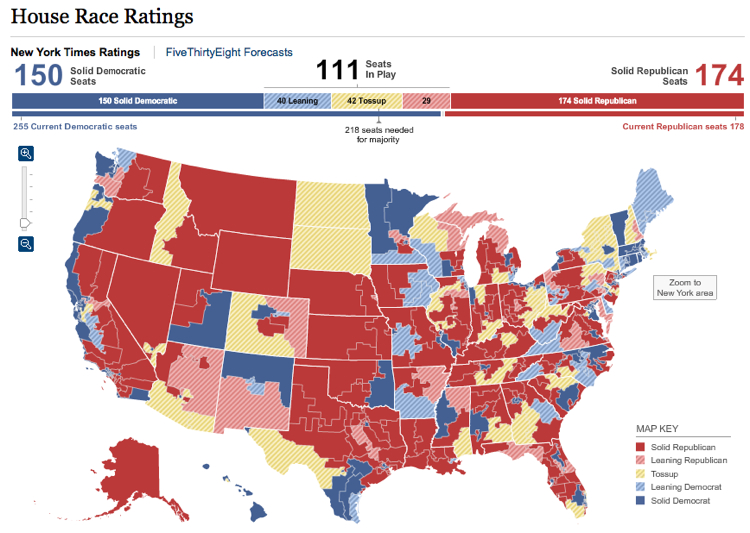
Just two years after sweeping to power and gaining control of the Presidency and Congress, the Democrats lost a massive amount of seats in the House and Senate, as well as several state governorships, during the 2010 midterm elections in a stunning resurgence for the Republican party. Is this turnaround the "will of the people", a strong rebuke of the "liberal policies" of President Obama and the Democrats, as many Republicans are wont to say? Well, that depends. It depends on how many people voted, who voted, and why they voted for whom they did.


According to the U.S. Census Bureau, there are roughly 210 million or so eligible voters in the United States. In 2008, 63% or 131,000,000 voted in the Presidential election. The 2010 midterms saw this number fall to just 89 million, which translates to about 40% voter turnout. This kind of lower turnout is normal for midterm elections, but nevertheless it means that a substantial amount of citizens stayed at home, either those who voted in 2008 and those who did not.

Does a 40% minority of eligible voters represent the "will of the American people"? No, not really. Not at all, actually, when one examines a bit further who of this 40% voted.

According to exit polls, embarrassingly low amounts of young people and minorities exercised their democratic rights this past November. Millions of Obama supporters, who had helped elect him in 2008, stayed home. 29 million or so, to give an estimate. On top of that, 13% of people who had voted for Obama in 2008 switched sides and voted Republican in 2010. As well, the people who did vote tended much more strongly to be middle-aged or senior citizens, white, and conservative or at least Republican-leaning. Many self-proclaimed moderates also favored the Republicans more so than Democrats.

This older, more homogeneous, more Republican demographic that turned out returned to the Republicans previously conservative strongholds that had swung to Obama and the Democrats in 2008, as well springing a few surprises on established Democratic incumbents, like in Illinois and Wisconsin. Indeed, the more fiscally conservative and moderate Blue Dogs lost half of their seats to Republicans in districts that had gone to the Democrats in the previous election.


The reasons for why so many Obama supporters and Democratic voters either didn't show up or voted Republican can be discussed in a separate article. The main question is what the most important issue was to those who bothered voting, and the answer is overwhelmingly because of the poor state of the economy. It's clear that few Americans have much faith, if any, in Congress and that President Obama's fiscal policies have not done enough to spur economic growth. Despite some neo-conservative claims that voters were rejecting the Democrats' and Obama's liberalism, the fact is that most people didn't consider the President's policies when deciding for whom to vote. 63% of voters said the economy was the most important issue to them, and those who said so voted 54% to 43% for the Republicans.

So moderate voters went more for Republicans to see if they could fix the economy any better than the Democrats had for the past 2 years (no doubt unaware, unwilling to recognize, or uncaring that the Republicans had in the most dickish fashion possible blocked and obstructed any and every form of economic assistance put forth by the Democrats). Republican voters unsurprisingly voted for Republicans, which combined with the moderate voters' economic concerns and liberal disillusionment with President Obama and the Democrats to hand the GOP a huge political win.


Pretty straightforward, really. The 2010 midterms seemed to be more a fragmented, haphazard display of the American two-party system, albeit accidentally. Of course, there are also the plutocratic reasons for the GOP victory: Some voters might have thought evil things about government, health care, Obama, the deficit, etc. But in American politics, money talks and money largely went with the Republican party; conservative organizations outspent liberal ones 2-1, and large special-interest industries bankrolled Republican campaigns. This was the most expensive midterm election ever, with over $4 billion spent; is it surprising that special-interests, corporations, and Big Money industries spent large amounts of cash on politicians who were far to the right of the President's mildly liberal rhetoric of reform?

A representative democracy should reflect the wants, needs, and opinions of the populace; American democracy increasingly is representative of only a small portion of population, either through plutocracy or voter apathy as a indirect result of plutocracy. The will of conservatives is certainly clear now; they demonstrated that simply by showing up at the polls, something that liberals and Democrats did not nearly do enough of to hold back the Right. Conservatives clearly want less government spending, lower taxes, a repeal of healthcare, blah, blah, blah. But what does the rest of the country want? What do the vast majority of Americans want? Not what the GOP is selling, that's for sure.

What does this mean for the future? The Republicans can no longer simply oppose any and everything the Democrats propose for the purpose of painting the President a failure...or maybe they can. They may try to throw some meat to their base and repeal health care, but that is extremely unlikely to pass. They may end up compromising with Democrats on certain issues, and be obstructionist and irresponsibly selfish on other subjects, which very well could end in a suspension of the government. Such a fiasco would unquestionably harm the country, but this is what people voted for and what they may receive.

At a time of deep economic crisis, the United States requires leadership, responsibility, cool heads, and sensibility. Unfortunately, it does not appear that the people will get this with the incoming group of Republicans, but time will only tell.

Tuesday, September 28, 2010

Runaway Capitalism: The Biggest Threat to America

The United States is reeling. Reeling from the strain of fighting wars in two different countries, reeling from the worst economic crisis in 80 years, reeling from a political climate that makes it extremely difficult to tackle the preponderance of problems facing the country.

With unemployment hovering near 10%, and underemployment much higher, the poor economy is on most people's mind. Many are angry at the government for lack of success in creating jobs. Many are also angry at the amount of money spent to save Wall Street, the Auto Industry, and the Big Banks, allowing CEOs and other millionaires to lavish themselves with huge bonuses while ordinary Americans are finding it increasingly difficult to get by.

The last time income inequality was this high was the Great Depression

Some recent statistics paint an even more dire situation:

Over 43 million Americans live under the poverty line, which goes up to 60 million when other factors are taken into consideration. This is equivalent to one in seven Americans.

50.7 million Americans are uninsured.

In 2005, the income of the top 20% of society was 1,500% higher than that of the lowest 20%, the highest gap ever recorded.

For the latest year that data was compiled, the tax rate for multinational corporations in the United States was about 2.3%, a significantly lower amount than ordinary Americans.

The financial sector's share of domestic corporate profits right before the economic crisis was 41%, up from 16% in 1973.

The share of total income by the top 10% of society went from 34.6% in 1980 to 48.2% in 2008.
The share of total income by the top 1% of society for the same time period went from 10% to over 20%.

Real median income for working-age households has fallen over the same time period.


Income inequality in the United States has widened over the past several decades, making America not only more unequal than other developed countries but one of the most unequal in the world.

Ordinary Americans are struggling to find a job and make ends meet, while those responsible for the financial crisis, Wall Street and the Big Banks, were bailed out by taxpayer money and are able to hand out huge paychecks to CEOs.

The top 25 hedge fund managers earned over $25 billion last year, in the midst of an economic recession larger than any in recent memory.

Over the past several decades, the rich have gotten richer, the middle class and the poor have remained stagnant, and income inequality has increased exponentially. The United States is in danger of becoming a Third World country.

How did this happen? Corporate money and special interest lobbyists have flooded Congress with funds, making politicians beholden to those who have given them the most capital, and not their constituents, the American people. Decades of ever more deregulation and lower taxes, as well as loopholes large enough to drive through, have exacerbated this situation to disproportionately and deferentially help the rich at the expense of the less well-off.

Both parties have encouraged this behavior, and during this most recent crisis, with widespread popular support to hold accountable those responsible for creating this situation, the Democrats and the Obama administration negotiated directly with those they would try to regulate, making concession after concession until the final bill was basically meaningless, as far as real reform was concerned. Of course, this hasn't stopped Wall Street financiers from complaining about Obama's "anti-business" policies, though this sentiment could not be farther from the truth.

Wall Street and other corporate influences need to be reformed

This is the result of runaway capitalism, whose corporate and special-interest influence extends over the U.S. government, basically running the economy and shaping policies that directly benefit themselves at the expense of the rest of the country.

Capitalism is not evil. Its ability to create wealth can be used to help people from all strata of society, not just the rich. It only becomes cruel when it is allowed to run its logical path, with profit as the only motivating factor and ever-increasing wealth going to an ever smaller circle of those at the top of the pyramid.

The influence of private money on Congress, elections, and politics in general in the United States is out of control. Many on the left point the finger mainly at the Republican Party, but the Democrats are guilty of the same crime. It is impossible to either gain or maintain political power in the United States without corporate or private money of some kind.

As a result, American democracy is under attack, with the voice of the people unable to be heard over the drone of private money. If this trend of increasing income disparity and corporate and special-interest money influence over political policies continues, the United States will become substantially weakened and degrade into a Third World country.

This vicious cycle is what is truly at stake in America.

The American people want to reform Wall Street, so that they can never again have the ability to bring down the rest of the country's economy. They want universal health care. They want better public education. They want the rich to pay their fair share of taxes. They want to help the environment. They want job security, unemployment benefits, higher minimum wages, and other things that Big Business would not agree to otherwise.

The only thing standing in the way of real progressive reform is the ruling-class of millionaires, billionaires, corporations, and special-interests, all of whom have the most to lose from their loss of privilege.

The solution is to take the money out of politics: Clean elections, clean politics, clean politicians.

Publicly-financed campaigns would make politicians beholden to the people, not the corporations.

Lobbyists are not inherently bad. They only become so when the difference in disposable income to spend means that an environmental lobby can spend $10 million for all of Congress while a corporation who pollutes the environment can spend the same amount on a single senator. Putting a cap on the amount of money lobbyists can spend would equalize the playing field.

The battle to implement clean elections will not be easy, as the recent Supreme Court ruling that allows corporations the same amount of free speech as an individual citizen shows. This is something that every American should want, in order to reclaim political power for those whose right it innately is.

True, progressive reform of campaign financing and economic-political structures is absolutely vital for a better, more prosperous, more equal, more democratic America.