Sunday, July 25, 2010

World Cup 2010 Review: Germany

Current Rank: 4
Expectations going in: Low
Finished: 3rd place

Germany went into the 2010 World Cup with a mixture of youth and veterans, inexperience and experience. Most pundits predicted the German team would struggle to perform up to their usual high standards, especially when talismanic captain Michael Ballack was injured before the beginning and ruled out of the tournament.

With expectations so low, the Mannschaft had nowhere to go but up. In their opening game against Australia, Germany scored early and dominated the match, absolutely destroying the Socceroos 4-0 thanks to goals from Mueller, Podolski, Klose, and Cacau. Almost immediately, the press labeled them once again as contenders for the title, after having finished in 2nd in 2002 and 3rd in 2006.
Cacau punctuated Germany's dominance with the fourth goal against Australia

However, the Germans' group was no easy task, the lopsided score against Australia not withstanding. Germany next played a strong Serbian side, looking to stave off elimination after having lost their first game against Ghana.

The Germans started out strong, but Miroslav Klose accumulated (harshly) 2 yellow cards early on in the match, and the resultant advantage for Serbia resulted in a goal shortly thereafter. However, despite being down to 10 men and losing 1-0, Germany went on to dominate the rest of the match. A penalty midway through the second would have tied the game, but Lukas Podolski saw his shot saved, and the Serbians held on for the win, thereby also giving Germany its first group-stage loss at a World Cup since 1986.

The stage was set, then, for Germany to take its World Cup destiny in its own hands for the last group match against the hitherto undefeated Ghana. Being unable to rely on the predatory instincts in front of goal of Miroslav Klose, the Germans were relegated to attempting to pass their way into the goal and taking long-distance shots - both of which, for much of the match, were unsuccessful. However, a brilliant act of creativity by Mesut Oezil saw the youngster's rocket from the top of the box fly into the corner, thereby giving Germany the win they needed to advance out of the group stage.
Mesut Oezil celebrates his goal with teammates

Awaiting them in the knockout rounds was traditional rival England. A rematch of the 1966 World Cup final had many neutral observer and rabid fans's mouths alike salivating. England had been disappointing up to that point in the tournament, and for the first 30 minutes of the match, it continued in much the same vein, with Germany taking a quick 2-0 lead through Klose and Podolski (who else?).

However, the looming threat of elimination seemed to galvanize England, and they pulled a goal back quickly before culminating in what they thought was the equalizer from Frank Lampard on the stroke of halftime. However, despite the ball crashing in off the crossbar and clearly going over the line, the referee did not award a goal and the score at halftime was 2-1 for Germany.

The possibilities of what would have happened after that goal had been allowed could be discussed endlessly, but the reality of the 2-1 score meant England had to attack to have any chance of coming back into the game. However, Germany was expecting this and transitioned effortlessly into a brutal and punishing counterattacking style that rewarded them with another 2 goals, to finish the game 4-1. Cue wild celebrations across Germany and despondence and despair in England.
If England had been feared to give Germany a run for their money, their next opponent were even more so: Argentina. Argentina had been running through their opponents, easily winning their group and looking classy while doing so. Two favorites entered this quarterfinal match in what was thought to be a very entertaining and attacking match.

An early mistake by the Argentinian goalkeepr allowed Thomas Mueller to score early on for Germany, and from that point on, Germany was content to simply soak up Argentina's relentless attacks and respond quickly on the counterattack. As Argentina became more frustrated by their lack of results in front of goal, their play became sloppier and this allowed Germany's forwards to slip by them. Once the second goal went in, Argentina's players seemed to deflate, and the next two seemed to just be for fun for Germany. A 4-0 final scoreline emphasized Germany's attacking and defending strength. Germany was simply dominating every team they met, with scores of 4-0, 4-0, and 4-1 padding their goal differential.
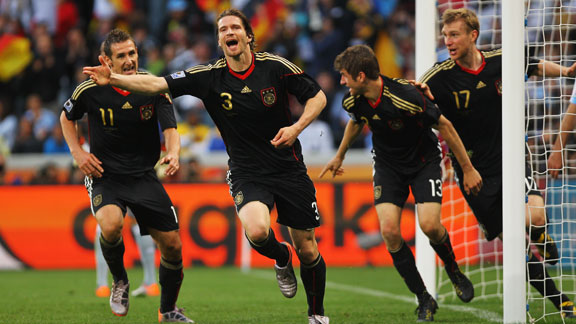
Defender Arne Friedrich's goal was the icing on the cake against Argentina

After tearing through their opponents in the group stage and the knockout rounds, Germany finally met a team that had had their number in previous meetings: Spain. The reigning European Champions had faced a defensive-minded team in every game they played, which allowed them to simply play to their strengths in outrunning and outpassing their opponents. It was hoped that Germany's attacking talents would be able to counterbalance the Spanish domination in passing and a remarkable game would emerge.

However, Germany would have to do without a vital player in forward Thomas Mueller, who had received an accumulation of yellow cards that forced him to sit out. Against Spain, this missing link was crucial, as Mueller was often the driving force behind the strong German counterattacks that created so many chances and ended in so many goals.

Germany tried to stifle the Spanish passing through the middle and attempted to create swift counterattacks, but these mostly proved ineffective and eventually the Spanish goal came late in the second half off of a corner kick, and once again Germany lost to Spain 1-0 in a major tournament's knockout rounds.

Though Germany were naturally disappointed, they could still hold their heads up high. The Germans reached their third semifinal in a row at the World Cup, following their performances at the 2002 and 2006 World Cups. A 3-2 win in the third-place match against Uruguay helped restore some of the lingering negative effects of the semifinal loss to Spain.

How did Germany achieve such a fantastic result with players who have so limited experience? Many of the younger players had been on the German youth teams that won every tournament they entered in. That's right. The UEFA U-17, U-19, and U-21 champions were all Germany in the years leading up to the 2010 World Cup. No other nation has achieved that feat before. Watching the 4-0 win over England in the U-21 final, many of the players on that squad also made the full squad in 2010.


Germany's youth program is clearly one of the best in Europe and the world. Following disappointing results in the 90's and early 2000's, the Deutscher Fussball Bund made changes to its youth policies, and since then, every Bundesliga side has invested heavily into their youth program, which has resulted in a vast quantity of talented players coming through the ranks that look as though they are more than able to fill the shoes of aging players.

Though they came up just short in 2010, the German team looks like it will be a major contender for several more tournaments to come. The more experience and playing time their youth players get at the international level, the more the team will acquire cohesion, and this can only mean bad things for the rest of European football. The future is definitely bright for German football.

Thursday, July 22, 2010

World Cup 2010 Review: United States of America

Current Rank: 13
Expectations going in: Medium
Finished: Round of 16

For the first time in its World Cup history, the United States entered the tournament with a group that it could reasonably expect to advance from, with matches against England, Slovenia, and Algeria.

Many fans remembered the U.S.'s fantastic appearance at the 2009 Confederations Cup, also in South Africa, when the Americans surprised the number one ranked Spanish 2-0 and lead 2-0 against Brazil before succumbing in the final. It was hoped that this kind of performance could be repeated a year later at the World Cup.

The United States surprised the world in 2009. Could they do it again in 2010?

Most of the pre-tournament hype focused on the opening game against an England squad full of superstars and expected to go far. The expectations among many American fans was that the U.S. would lose the first game against England, but then go on to defeat Slovenia and Algeria to qualify for the Round of 16, and then who knows what could happen?

It seems, however, that this group was one in which predictions weren't really terribly accurate.

In the first game against England, the U.S. had trouble focusing early on and gave up an easy goal to England with under 10 minutes played. The Americans fought back, however, and managed to squeak one by the beleaguered Robert Green to even the score. It could have even ended in a USA victory, had Jozy Altidore not had his shot parried on to the crossbar in the second half.

With a better-than-expected point against England, the U.S. could now look towards their next game against Slovenia, who had not looked very impressive in laboring to a 1-0 win on another goalkeeping error over Algeria.

The Americans again started slow, this time being much more severely punished, as Slovenia ripped open the United States defense for a 2-0 halftime lead. It seemed then that the U.S.'s dreams at the World Cup had been destroyed in only 45 minutes, as England were due to play Algeria later in the day, and it was widely expected for the English to prevail quite easily.

The United States showed its comeback spirit, though, and Landon Donovan smashed home a goal early in the second half to spark the revival. The U.S. slowly gained more and more momentum, finally equalizing late in the game through Michael Bradley.
Michael Bradley

The match was now 2-2, but it wasn't quite over yet. There was still time for Maurice Edu to convert a Landon Donovan free kick to give the United States an improbable but highly-deserved 3-2 victory in the dying moments....except Malian referee Koman Coulibaly blew his whistle for a phantom foul, drawing vehement protests from the American players. Upon further review, the call was even more ludicrous, given that there were no players offsides, and several American players were actually being pulled down by Slovenian defenders - which should have been a penalty, in any case.
American players were outraged

American fans took this as yet another case of a FIFA conspiracy to rob the United States of legitimate goals (another example is the non-call on a handball in a quarterfinal match against Germany in 2002), and after offering no explanation as to what made him decide to blow his whistle, no one was satisfied.

So with a 2-2 draw, and not a 3-2 win, the U.S. went into its final match still in control of its destiny - win or go home. England's embarrassing 0-0 draw against Algeria meant any team in the group still had the ability to either advance or be eliminated. The U.S. knew they had to defeat Algeria and they'd go through.

The game was for almost the entire match going one-way, with the U.S. constantly attacking, trying to find that opening goal. Algeria hit the crossbar when they really should have scored, and the U.S. scored a legitimate goal that was wrongly called back for being offside (again).

In the 92nd minute, Tim Howard collected a rare ball brought forward by Algeria, distributed it halfway down the field to Landon Donovan, who brought it forward and crossed for Clint Dempsey. Dempsey's shot was saved, but Donovan got the rebound, and the celebrations began. Across the United States. delirious fans joyously reacted and partied like it was August 14, 1945:


More videos can be found here.

Landon Donovan and Clint Dempsey

Thanks to Donovan's goal, the United States advanced to the round of 16, finishing first in their group ahead of England. Next up would be Africa's only remaining side: Ghana. Ghana was the side that had defeated the United States in the third group match of 2006, eliminating the Americans and allowing Ghana the chance to play Brazil in the round of 16. Of course, the only way the Ghanaians could do so was through an incredibly dubious penalty call immediately following a U.S. goal on the stroke of halftime (yet another example of American fans' bitterness towards FIFA). The stage was set for revenge.

However, coach Bob Bradley erred in his starting eleven and Ricardo Clark gave up the ball in the opening few minutes of the game which directly lead to Ghana's opening goal. He was soon thereafter replaced. After once more giving up a goal in the opening minutes of the game, (3rd time out of 4 matches), the United States fought back once more, equalizing on a Landon Donovan penalty midway through the second half. The teams could not be separated, and the match went to extra-time. Ghana was again allowed a defensive breakthrough and scored early in the extra period, putting the Americans on the backfoot yet again. This time, however, there would be no reply. The U.S. just could not muster yet another comeback, and they fell 2-1 in extra time to Ghana.

Going out in extra time in the round of 16 is a respectable result, and clearly soccer in the United States has come a long way since the dark days of the late 80's and early 90's, when the country first started regularly qualifying for the cup. In addition to the vast outpouring of support and passion for the national team across the country, television ratings were extremely high: 14 million Americans watched England vs the U.S., and more than that watched the game against Ghana. If counting Univision's Spanish-language coverage, more than 20 million people watched games involving the United States, which is much more than either the Stanley Cup or the NBA Finals enjoyed.

Hopefully these statistics, as well as the United States' performance, can put to an end the constant deliberating about whether or not soccer has "made it" in America. What's clear is that the sport already has "made it", and it's been there for a long time. It just took this World Cup to reveal that part of American soccer culture to the rest of the skeptics, and hopefully this can equate to future growth for the sport.

While the future looks bright for U.S., with more and more players coming through the youth ranks and turning professional earlier and earlier, what is worrying for the United States Soccer Federation is that, for the second tournament in a row, a U.S. forward failed to score a goal. Also, the core backline of the defense is aging, and something must be done to repair the early-game mentality to eliminate those deficits that occurred so often. There is also a question of what to do about Bob Bradley: Has he taken the team as far as he can take them? Should the USSF bring in a foreign coach, or someone with inside knowledge of the American soccer landscape? Should he stay on?


The U.S. team watches a replay of Landon Donovan's goal against Algeria after the Americans won, 1-0

For now, these questions can go unanswered, while the afterglow of 2010 fades away. Even though the U.S. was eliminated a bit earlier than many would have liked, they can hold their heads up high, and soccer fans will always have Donovan's goal to look back on and smile.

Thursday, July 15, 2010

World Cup 2010 Review: England

Current Rank: 7
Expectations going in: High
Finished: Round of 16

England qualified for the 2010 FIFA World Cup with relative ease, and there was much talk before the tournament about how this could be "England's year" to finally bring home a coveted second World Cup title from South Africa. The English, actually, could not have asked for a better group, with the United States, Slovenia, and Algeria rounding out the first couple of games for them. The Sun summed up this feeling quite nicely:
With a core group of elite players, many of whom play in the "best league in the world" on some of the best teams in the world, England fans were dreaming big. It seemed as though things had finally come together, especially after finally getting a world-class manager in Fabio Cappello, who had a pedigree of success in his prior endeavors.

Unfortunately, the English let down their fans, as they so often do, in less-than-noble fashion. Their opening game against the United States was much hyped, both in England and the States. England started out at a fast, brilliant pace, with Gerrard opening the scoring in under 5 minutes, and boy, for those first couple of minutes, England could have beaten anyone.

This level of play, however, was not to last, as goalkeeper Robert Green, in another incident in which an English goalkeeper has blundered on a big occasion, fumbled a weak shot from Clint Dempsey in embarrassing fashion, allowing the Americans to draw level, which is how the game finished.
While a draw against the United States could be seen as a bit surprising, it was still respectable. England next faced an Algeria team that they should have been able to dominate, on paper. In what was essentially an England home match, with English supporters being by far more numerous than Algerian, neither team could really establish themselves or even convince spectators that they were, in fact, watching a game of football, and not just a bunch of men running around in shorts who were trying to break a sweat for the fun of it. The match finished 0-0 and was so poor, so disappointing, that England fans began to boo at the final whistle, prompting Wayne Rooney to criticize them to the camera.

Fortunately, England still controlled their own destiny, as the United States was robbed of a last-minute goal against Slovenia, leaving their match also drawn, 2-2, and ensuring that any team could still qualify or be eliminated going into the final group match.

All England had to do was defeat Slovenia and they would qualify for the next round. On this day, the English showed up, at least for the first hour or so, and managed to get a goal through Jermaine Defoe. The last quarter hour, though, saw Slovenia manage several near-misses that must have been giving players, supporters, and management all kinds of fits and chewed-down nails.

England managed to hold on for the 1-0 win, although they failed to win the group, finishing second behind the United States. Apparently, the group was not as "easy" as predicted.

This, however, set up a mouth-watering clash with Germany in the round of 16, a team that had shown its scoring abilities in a 4-0 demolition of Australia in those teams' first match.

The Germans had a formidable attacking formation, and this was proven in no uncertain way when they opened up a 2-goal lead over a tired-looking and unmotivated England side. An amateurish mistake allowed German goalkeeper Neuer to simply clear the ball down the field to Miroslav Klose, who ran by England's defense and prodded the ball past a hapless David James. Lukas Podolski capitalized on another flowing German move by arrowing the ball past James some minutes later, making it absolutely do-or-die time for England's World Cup hopes after barely having even played 30 minutes.

Being down 2-0 seemed to finally awaken England, as they upped the tempo and pulled one back through Matthew Upson. Shortly after that, at 2-1 and just before halftime, Frank Lampard hit a shot that appeared to go across the line before being pulled back out again. With the referees in perfect position to judge, they got the call wrong, and the scored stayed 2-1 at halftime.


In the second half, England knew they needed to attack to break down a solid German defense, and this is exactly how Germany punished them, scoring 2 goals in quick succession on the counterattack, to flatter the scoreline a bit, but also send English football into a tailspin of doubt, humiliation, and despair.

And thus begins, after such an ignoble defeat, and on the back of 1 win and 3 goals in 4 matches, the soul-searching for what went wrong and how to improve in the future for English football.

One obvious answer is youth development and the Premier League. The core group of the England side that went to South Africa (Lampard, Rooney, Gerrard, Terry, etc.) are world-class athletes, but most are not getting any younger, and the depth of talent that exists to replace them, should they need to, is frankly inadequate. The younger talent coming up through the ranks in England are just not good enough. Compared to Germany, which invests over 4 times as much in its youth program as England does, the difference in depth and talent is startling.

With over 60% of players in the Premier League coming from outside of England, many English players are not getting quality time playing football at a very high level. There is no single body that oversees youth development in England, again in contrast to Germany. Many clubs in England have enough money that they can simply spend millions on cheaper, foreign imports rather than the inflated price given many times to home-grown players. Germany had this same problem in the mid-90's, lasting through to their disastrous EURO 2000 and EURO 2004 performances. England has had troubles of their own, failing to qualify for EURO 2008 and disappointing at the 2010 and 2006 World Cups.

Further hampering England's chances at winning a major trophy is their attitude. The media doesn't help this, no doubt, but England's players and fans all expect their team to be in among the elite, playing at a level akin to Brazil, Spain, or the Netherlands. This is simply an illusion, and a dangerous one at that. How many legitimately good, quality, world-class teams have England beaten in the past several years? They did recently defeat Croatia in Zagreb, which was very impressive. Aside from that, all that comes to mind is going out to Portugal on penalties in two straight tournaments, almost beating France in EURO 2004, and barely squeaking by a deplorable Argentina side in 2002 thanks to a David Beckham penalty.

If the results haven't really been that great in the past several years, where does England get this attitude from, that they're better than any other team simply because they know they are? It's arrogant, and it costs them games. From expecting to easily win their group at the World Cup (why do the other teams even bother to show up?), to looking down upon nations with players who, gasp!, don't play in England, the English have a mental problem that is inconsistent with reality. It doesn't matter whether you have Wayne Rooney, Frank Lampard, or John Terry if you cannot play well and win games with them. England lacks depth, flair, style, and humility.

So what can England do to fix their problems? By investing more into their youth academies, restructuring the organization of developing youth in England, reducing the amount of foreign players in the Premier League, and eating a good, healthy dose of humble pie, the English have a great chance at seeing themselves destroy another big team in the knockout rounds of a major tournament, and maybe even more than that, if they follow through with these steps outlined above.