Thursday, July 15, 2010

World Cup 2010 Review: England

Current Rank: 7
Expectations going in: High
Finished: Round of 16

England qualified for the 2010 FIFA World Cup with relative ease, and there was much talk before the tournament about how this could be "England's year" to finally bring home a coveted second World Cup title from South Africa. The English, actually, could not have asked for a better group, with the United States, Slovenia, and Algeria rounding out the first couple of games for them. The Sun summed up this feeling quite nicely:
With a core group of elite players, many of whom play in the "best league in the world" on some of the best teams in the world, England fans were dreaming big. It seemed as though things had finally come together, especially after finally getting a world-class manager in Fabio Cappello, who had a pedigree of success in his prior endeavors.

Unfortunately, the English let down their fans, as they so often do, in less-than-noble fashion. Their opening game against the United States was much hyped, both in England and the States. England started out at a fast, brilliant pace, with Gerrard opening the scoring in under 5 minutes, and boy, for those first couple of minutes, England could have beaten anyone.

This level of play, however, was not to last, as goalkeeper Robert Green, in another incident in which an English goalkeeper has blundered on a big occasion, fumbled a weak shot from Clint Dempsey in embarrassing fashion, allowing the Americans to draw level, which is how the game finished.
While a draw against the United States could be seen as a bit surprising, it was still respectable. England next faced an Algeria team that they should have been able to dominate, on paper. In what was essentially an England home match, with English supporters being by far more numerous than Algerian, neither team could really establish themselves or even convince spectators that they were, in fact, watching a game of football, and not just a bunch of men running around in shorts who were trying to break a sweat for the fun of it. The match finished 0-0 and was so poor, so disappointing, that England fans began to boo at the final whistle, prompting Wayne Rooney to criticize them to the camera.

Fortunately, England still controlled their own destiny, as the United States was robbed of a last-minute goal against Slovenia, leaving their match also drawn, 2-2, and ensuring that any team could still qualify or be eliminated going into the final group match.

All England had to do was defeat Slovenia and they would qualify for the next round. On this day, the English showed up, at least for the first hour or so, and managed to get a goal through Jermaine Defoe. The last quarter hour, though, saw Slovenia manage several near-misses that must have been giving players, supporters, and management all kinds of fits and chewed-down nails.

England managed to hold on for the 1-0 win, although they failed to win the group, finishing second behind the United States. Apparently, the group was not as "easy" as predicted.

This, however, set up a mouth-watering clash with Germany in the round of 16, a team that had shown its scoring abilities in a 4-0 demolition of Australia in those teams' first match.

The Germans had a formidable attacking formation, and this was proven in no uncertain way when they opened up a 2-goal lead over a tired-looking and unmotivated England side. An amateurish mistake allowed German goalkeeper Neuer to simply clear the ball down the field to Miroslav Klose, who ran by England's defense and prodded the ball past a hapless David James. Lukas Podolski capitalized on another flowing German move by arrowing the ball past James some minutes later, making it absolutely do-or-die time for England's World Cup hopes after barely having even played 30 minutes.

Being down 2-0 seemed to finally awaken England, as they upped the tempo and pulled one back through Matthew Upson. Shortly after that, at 2-1 and just before halftime, Frank Lampard hit a shot that appeared to go across the line before being pulled back out again. With the referees in perfect position to judge, they got the call wrong, and the scored stayed 2-1 at halftime.


In the second half, England knew they needed to attack to break down a solid German defense, and this is exactly how Germany punished them, scoring 2 goals in quick succession on the counterattack, to flatter the scoreline a bit, but also send English football into a tailspin of doubt, humiliation, and despair.

And thus begins, after such an ignoble defeat, and on the back of 1 win and 3 goals in 4 matches, the soul-searching for what went wrong and how to improve in the future for English football.

One obvious answer is youth development and the Premier League. The core group of the England side that went to South Africa (Lampard, Rooney, Gerrard, Terry, etc.) are world-class athletes, but most are not getting any younger, and the depth of talent that exists to replace them, should they need to, is frankly inadequate. The younger talent coming up through the ranks in England are just not good enough. Compared to Germany, which invests over 4 times as much in its youth program as England does, the difference in depth and talent is startling.

With over 60% of players in the Premier League coming from outside of England, many English players are not getting quality time playing football at a very high level. There is no single body that oversees youth development in England, again in contrast to Germany. Many clubs in England have enough money that they can simply spend millions on cheaper, foreign imports rather than the inflated price given many times to home-grown players. Germany had this same problem in the mid-90's, lasting through to their disastrous EURO 2000 and EURO 2004 performances. England has had troubles of their own, failing to qualify for EURO 2008 and disappointing at the 2010 and 2006 World Cups.

Further hampering England's chances at winning a major trophy is their attitude. The media doesn't help this, no doubt, but England's players and fans all expect their team to be in among the elite, playing at a level akin to Brazil, Spain, or the Netherlands. This is simply an illusion, and a dangerous one at that. How many legitimately good, quality, world-class teams have England beaten in the past several years? They did recently defeat Croatia in Zagreb, which was very impressive. Aside from that, all that comes to mind is going out to Portugal on penalties in two straight tournaments, almost beating France in EURO 2004, and barely squeaking by a deplorable Argentina side in 2002 thanks to a David Beckham penalty.

If the results haven't really been that great in the past several years, where does England get this attitude from, that they're better than any other team simply because they know they are? It's arrogant, and it costs them games. From expecting to easily win their group at the World Cup (why do the other teams even bother to show up?), to looking down upon nations with players who, gasp!, don't play in England, the English have a mental problem that is inconsistent with reality. It doesn't matter whether you have Wayne Rooney, Frank Lampard, or John Terry if you cannot play well and win games with them. England lacks depth, flair, style, and humility.

So what can England do to fix their problems? By investing more into their youth academies, restructuring the organization of developing youth in England, reducing the amount of foreign players in the Premier League, and eating a good, healthy dose of humble pie, the English have a great chance at seeing themselves destroy another big team in the knockout rounds of a major tournament, and maybe even more than that, if they follow through with these steps outlined above.

Tuesday, July 13, 2010

The United States is a Secular Nation

A recent sex scandal in Indonesia has opened up a can of worms over the role of religion and secularism in that country. Why is this relevant to anybody that doesn't live there? Indonesia is the most populous Muslim country in the world, and many are debating about what to do about young people using the Internet, which helped spread the sex tape in question, as well as opening up debate about attitudes toward sexuality. Here are some interesting statements about the situation from the BBC article:

More than 80% of Indonesians are Muslim, and while it is a secular nation, most people are still largely conservative.

But that is changing, especially among young people who have access to information in a way their parents could never have dreamed of.


Uzham Izhar, 32, had brought her two-year-old daughter.

"We want to live in an Indonesia that follows Islamic values," she said, as she patted her daughter asleep on her lap.

"Islamic law isn't just for Muslims, it's for the whole country.

"This kind of country is very dangerous, and it is particularly dangerous for my young daughter. I don't want her growing up in this kind of Indonesia."


These very words could be transplanted to the U.S. and it would not be out of place at all. Many reactions towards changing policies that are favored by young people, such as support of gay marriage, has been opposed on religious, specifically Christian, grounds.

A common boast by conservatives is that "the United States is a Christian nation". Conservatives also claim that many or most of the Founding Fathers were inspired by Christianity and God when writing the Constitution, a document in which, in reality, there is no mention of Christianity, religion, or God at all.

Is the United States a Christian nation, though? God is, in fact, mentioned on national currency, and many court houses have the Ten Commandments present on their property. The president has been known to usually be sworn in by placing his hand on a Bible. There has also never been a non-Christian elected president of the United States (despite what some people say about Obama's "hidden Muslim" tendencies).

Certainly, the role of Christianity in American politics is substantial and influential, in that it would be very difficult to go far in the current political climate if one was anything other than non-Christian (or, in many cases, non-White as well).

As well, 76% of Americans said they were Christian in 2008. An even more impressive number would be the 34% of adult Americans who proclaimed to be Evangelical or Born-Again Christians. However, though these numbers may seem high, they are not incredible or shocking. Religious adherence has been on a steady decline in the U.S. for the past several decades, as more people are becoming apathetic to organized religion in general, not just Christianity.

If 76% of Americans are Christian (though this doesn't mean that they all go to church, or engage in other Christian-related activities), then that means that almost a quarter of the population, or over 50 million people, are not Christian.

Other countries, as well, have large swathes of population who consider themselves Christian. In Canada, 77% claim Christianity as their religion. In Spain, 73% are Christian. 88% of Italians are Catholic. In the United Kingdom, 71% of the population is Christian. In Germany, the amount is 67%.

Are these other countries considered "Christian nations" because the majority of citizens are Christian? All of this depends, of course, on what exactly is meant by "Christian nation". American conservatives appear to be using the term to indicate that the country is fundamentally Christian in its very fabric, due to the "Christian influences" on our Founding Fathers and written in our Constitution, as well as being in many other aspects of our history and politics, and of course because a majority of Americans say they are also Christian.

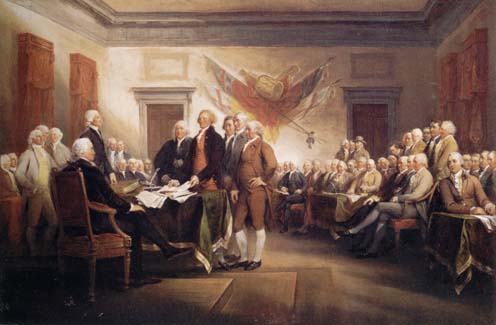
The Founding Fathers

Other countries don't seem to view the U.S. as a "Christian nation" in the same way that conservatives do. Though not exactly empirical, a quick glance at the French and Spanish Wikipedia pages for "Secular State" lists the United States as secular. However, the English-language page of the same category does not list the U.S. under the heading of "Americas". Why do Spanish and French language speakers consider the United States secular, but English-speaking Americans (who make up the majority of Wikipedia contributors/readers) do not?

The obvious problem with this belief is the contradiction that there is actually no reference to God in the Constitution. At all. Many Founding Fathers were not what we could really call Christian today, and much of the influence for the writing of the Declaration of Independence and the Constitution of the United States of America came from the Enlightenment, with such heavyweights as John Locke and Voltaire's influence being pretty noticeable. The motto "In God We Trust" actually wasn't added to our currency until the Civil War - much later than the 1780's, wouldn't you say?

This fact - that the United States is not founded on Christian principles, that the separation of church and state in American society is one of the bedrock foundations upon which the country was built - could not be more easier and well-summarized than by this statement in a peace treaty signed between the United States and Tripoli in 1797:

"As the Government of the United States...is not in any sense founded on the Christian religion--as it has in itself no character of enmity against the laws, religion, or tranquillity of Musselmen--and as the said States never have entered into any war or act of hostility against any Mehomitan nation, it is declared by the parties that no pretext arising from religious opinions shall ever produce an interruption of the harmony existing between the two countries."

This treaty was signed by President John Adams and ratified by the Senate in a unanimous decision. See, the Founding Fathers knew that the country had first been populated by crazy religious nuts who had fled (re: were kicked out) of their own countries for having insanely different religious views, and they didn't want to see the same kind of massacres, persecution, bigotry, and violence that had marked other countries who had adherents to different religions other than the official state's (check out the French Wars of Religion or the 30 Years' War).

Americans tend to think of the Puritans as noble, God-fearing, humble farmers who bravely traveled across the ocean at the beginning of winter to start a new, fresh life for themselves in America. They were actually kicked out of their home country, England, for being radically different in their views, from where they then fled to the Netherlands, a country known for its liberalness and openness to diversity, upon which they were once again thrown out.

If the United States were to have an official religion, which would it be? The problem with picking "Christianity", is that there are so many different sects of the religion that any single one being picked over another would cause dissidence and chaos amongst those who do not adhere to it. That is why the Founding Fathers knew that America must have a separation of church and state and remain secular.

Many on the Right choose to interpret such basic facts in the wrong way, sometimes even confusing which documents said what. This type of deliberate misconception of basic and fundamental American documents, that form the basis of our government, politics, society, and culture, has been going on for decades, and it needs to stop.

What will help this stop is for people to hear and understand the truth, which not only would educate those who are easily brainwashed (people who believe anything their mentors tell them without forming an opinion for themselves [Conservatives, duh]), but increase the amount of people who are politically active and involved, which is good for our democracy.

Barack Obama, not insane

Luckily, not everyone subscribes to this ludicrous notion concerning our Founding Fathers or the Constitution. Speaking at a press conference in Turkey, President Barack Obama said

"One of the great strengths of the United States," the President said, "is ... we have a very large Christian population -- we do not consider ourselves a Christian nation or a Jewish nation or a Muslim nation. We consider ourselves a nation of citizens who are bound by ideals and a set of values."

How refreshing! How logical! How correct! How idealistic! How... he was vilified by the Right.

It is imperative that the truth be told about American history, especially when in regards to such powerful and fundamental aspects of American life and society. A country that does not know its own history is free to make it up so that it suits them. It does not suit the Right to know that the United States is and has always been a secular nation, and therefore they are attempting to spread a lie so much that it becomes a truth. This cannot and should not happen.

Thursday, July 1, 2010

The Democrats Need to Grow A Pair

Obama on election night

The 2008 United States Presidential election witnessed a dramatic upheaval, as the Democratic Party gained majorities in both the House of Representatives and the Senate, not to mention the fact that a northern liberal was elected to the presidency for the first time since John F. Kennedy in 1960. The first-ever African-American president, Barack Obama, had motivated and moved many with his call for change, and change is what the American people clearly wanted after 8 long years of incompetent Republican leadership. Finally, progressive goals could come to fruition with a Congress capable of delivering on what would surely be the president's desires for "change we can believe in".

Early promises and wishful thinking, however, has turned into disappointment as President Obama's first term has gone on. The closing of Guantanamo in one year has yet come to pass. Progress in the Middle East has been slow in coming. Gay rights has taken a backseat to more pressing issues. More troops have been sent to Afghanistan, making the prospect of a sooner-rather-than-later withdrawal a bit more unlikely. Criticism from the Left has not been as harsh as that coming from the Right, but perhaps it should be.

One of the biggest complaints against the Obama Administration and the 111th Congress has been the lack of a public option for the Healthcare Reform Bill. It seems nobody is really that happy with the end result, although the reasons for disgruntlement vary. Some important points can be taken from those polls: 1) Many Americans are woefully ignorant of what the bill actually contains and what it will mean for them; 2) More people think the Democrats than the Republicans would be better for handling of reform of the industry; 3) Most Americans want to see more government involvement in dealing with reform of healthcare; 4) Many Americans feel that the bill did not "go far enough", i.e., they are disappointed over the lack of a public option.


Pro-Healthcare Reform rallies were not loud enough

The dithering and bipartisan pandering to Republican sentiments towards reform allowed the debate to slow down to a crawl, putting into jeopardy of fixing one of the most important issues currently facing the United States. Yes, the bill was eventually passed, and it is not perfect, but better than nothing. However, the manner in which it was watered-down and beaten made many tired of debate, almost killing it before it could become real. Though passage of this bill is meaningful, it is not meaningful enough.

With majorities in both the House and Senate, and a president willing to actively promote and endorse these causes, why did Democrats sink to the Republicans' level and attempt to negotiate with the minority? It is almost undeniable that, if given the same situation, Republicans would have simply rammed through the legislation of their agenda without needing to debate it with the opposition. It's as if Democrats were afraid of wielding their power as the majority. This type of bipartisan-flakery and watering-down is not even unique to the healthcare reform movement. And it's becoming old, really fast.

The Democrats stand on the precipice of enacting actual, meaningful progressive legislation in a country that is still very conservative, overall. This is a gilt-edged chance that may not come again, and so far, the lack of a spine has allowed actual progressive legislation to either be ignored, pushed back, or diluted by a divisive, ignorant, and idea-less opposition.

Which isn't to say that the President and Democrats haven't accomplished anything significant, either. Quite the opposite, actually. One of the biggest controversies (to Republicans, at least), the economic stimulus bill, seems to be working. Obama appears to be pretty popular, generally speaking, and this can only be a good thing for an American president, especially after the depths of anti-Americanism that sprang up while Bush was in office.

Criticism from the Left isn't so much about what has been accomplished (although the lack of a public option was truly heartbreaking) but rather the chance for the potential of meaningful, progressive change to be lost. The Democrats have achieved some goals, but they had and continue to have the ability to do so much more for the betterment of the country. Progressive legislation will always be an uphill battle in a country where the word "liberal" still carries a negative connotation. But this is no time for the Democrats, the president, or progressives to be cowed by their opponents. Rather, the Left needs to stand up, be brazen, be bold, be aggressive and do what they know needs to be done, regardless of criticism or complaints from the other end of the political spectrum. The Democrats have it in their power, they just need to develop a spine, grow a pair, and the benefits will come their way for years to come.